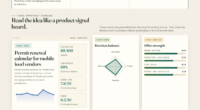
📊 Full opportunity report: The $9 Billion Signature Tax: How DocuSign’s Business Model Survives on One Assumption on ThorstenMeyerAI.com — validation score, market gap, and execution plan.

Get smart everyday buys delivered free with Prime
- Fast, free delivery on millions of items
- Prime Video, Amazon Music and more included
- Member-only deals all year
TL;DR
DocuSign, valued at $9 billion, operates on a business model based on user inertia and high licensing fees. An open source alternative, DocuSeal, demonstrates the potential to disrupt this model by offering a free, self-hosted signing solution. The development raises questions about the longevity of DocuSign’s pricing monopoly.
In 2023, the open source project DocuSeal was launched, offering a fully functional, self-hosted digital signature platform built on open standards. This development directly challenges the proprietary dominance of companies like DocuSign in the digital signature market, which has traditionally relied on high licensing fees and user inertia.
DocuSign’s revenue model relies heavily on high licensing fees, with a typical enterprise contract costing $17,250 annually, according to Vendr’s 2026 benchmark. The platform’s core functionality—digitally signing PDFs—is built on open standards and cryptographic solutions that have been available since the late 1990s. Despite this, most users pay premium prices, partly because they do not consider or are unaware of cheaper or free alternatives.
Meanwhile, the open source project DocuSeal, developed by a Ruby programmer in 2023, offers a fully functional, self-hosted digital signature platform built on open standards, licensed under AGPL-3.0. It features drag-and-drop PDF form building, multiple signer support, API integration, and compliance with legal frameworks like ESIGN, UETA, and eIDAS. The project has amassed over 11,800 GitHub stars and is maintained with active community support.
Deploying DocuSeal on a basic VPS costs approximately €45/year, a stark contrast to the thousands paid annually by enterprise clients for DocuSign. The process to set up the open source alternative takes about 30 minutes, making it a practical option for organizations seeking to reduce costs and increase control over their signing infrastructure.
The $9 billion signature tax.
DocuSign’s business model survives on one assumption.
A 50-person team pays $24,000 to $39,000 per year to put names on PDFs. Not because the tech is hard. The cryptographic signature math has been solved for thirty years. The legal frameworks are a quarter-century old. There is no moat. There is one assumption holding it together: that you will not bother to look at the alternative.
You are rationing digital signatures in 2026.
Stop and look at that sentence again. You are rationing — keeping a count, watching the meter, deciding whether this contract is worth using one of your remaining envelopes — a function whose actual cost to perform is somewhere between zero and one cent per signature. You are doing this in 2026, on a function that has been a commodity since 1999.
Same job. Different bill. Four team sizes.
Pure SaaS-vs-VPS comparison. As your team grows, the absolute savings grow linearly while relative savings asymptote at ~99.9%. The DocuSign business model assumes per-seat pricing on a function that has no per-seat marginal cost.
Five commands. Production-grade signature platform.
PostgreSQL 18 + DocuSeal app + Caddy reverse proxy with automatic Let’s Encrypt SSL. Verified against the official docusealco/docuseal repository at v2.2.9. 28 minutes if everything goes smoothly; 45 if DNS is slow.
Production deploy · $5/month VPS → live signature platform.
ssh root@IP
5 min
sign.you.com → IP · Cloudflare proxy OFF
5 min
curl -fsSL get.docker.com | sh · entire install
3 min
docker-compose.yml · set .env · docker compose up -d
10 min
DocuSign is not the only $9B company built on this assumption.
Same dynamic. Per-seat pricing on a function with near-zero marginal cost. Open-source alternative is mature, properly licensed, and runs on a $5 VPS. A typical 50-person company running 5–8 of these is paying $40K–$120K/year that’s structurally replaceable.
The first time you do this, you save $30,000. The savings are the surface. The actual outcome is that you stop trusting the SaaS price tag entirely.
How to Replace DocuSign in 30 Minutes for $5 a Month
The complete DocuSeal self-host guide for 2026. Every command tested. Every cost verified. Every workflow ready to run today.
- 30-min deploy walkthrough · v2.2.9
- 4 hosting options ranked by cost
- Production docker-compose.yml
- 13 field types · DocuSign mapping
- API patterns · CRM, billing, contracts
- Cost comparison · 1, 10, 50, 200 sizes
- Compliance · ESIGN, eIDAS, GDPR, HIPAA
- The 12-category replacement framework
- 5 questions before any SaaS swap
- Honest maintenance accounting
Implications for Enterprise Digital Signature Spending
This development questions the long-term viability of DocuSign’s high-margin business model. If organizations become aware of reliable, free, and self-hosted alternatives like DocuSeal, they could significantly cut costs, reducing the company’s revenue and market power. It also highlights a broader trend: essential digital infrastructure components, once considered proprietary, are increasingly commoditized and open source, challenging traditional SaaS monopolies.
For users, this means more control over data, compliance flexibility, and potential cost savings. For the industry, it signals a possible shift toward open standards and community-driven solutions in enterprise document management and signing services.
digital signature software open source
As an affiliate, we earn on qualifying purchases.
As an affiliate, we earn on qualifying purchases.
Historical reliance on proprietary digital signing platforms
Since the late 1990s, digital signatures have been governed by open standards and legal frameworks such as ESIGN (2000), UETA (2000), and eIDAS (2014). Despite the open nature of the underlying cryptography and standards, companies like DocuSign built their value on proprietary interfaces, integrations, and user experience. Their pricing models reflect a monopoly on convenience and integration, rather than technological exclusivity.
Recent years have seen the emergence of open source tools like DocuSeal, which leverage these standards to provide free, self-hosted solutions. Meanwhile, large organizations and governments have continued to rely on established providers due to contractual and compliance considerations, but the landscape is shifting as awareness grows about open alternatives.
“The core technology of digital signatures has been a commodity for decades; the real value is in the convenience and network effects that companies like DocuSign have built around it.”
— Thorsten Meyer
As an affiliate, we earn on qualifying purchases.
Remaining questions about enterprise adoption and legal acceptance
It is still unclear how quickly organizations will adopt open source solutions like DocuSeal, especially in regulated environments or where contractual obligations specify using certain providers. Additionally, the legal and compliance acceptance of self-hosted signatures in different jurisdictions remains to be fully tested, particularly for federal or notarial use cases.
As an affiliate, we earn on qualifying purchases.
Potential industry shifts and regulatory responses
Expect increased awareness and testing of open source signing tools by organizations seeking cost savings. Regulatory bodies and standard-setting organizations may also review legal frameworks to clarify the acceptability of self-hosted signatures, potentially broadening their use. Meanwhile, established vendors like DocuSign may respond with new features or pricing adjustments to maintain market share.
enterprise digital signature solution
As an affiliate, we earn on qualifying purchases.
As an affiliate, we earn on qualifying purchases.
Key Questions
Can organizations fully replace DocuSign with open source alternatives?
For most non-regulated use cases, open source solutions like DocuSeal can provide functionally equivalent digital signatures. However, organizations requiring federal or highly regulated contracts may face legal or contractual hurdles in replacing established providers.
Will self-hosted digital signatures meet legal requirements globally?
Many jurisdictions recognize digital signatures that comply with standards like ESIGN, UETA, and eIDAS. Self-hosted solutions that meet these standards can be legally valid, but acceptance varies by jurisdiction and specific use case.
How much money can organizations save by switching to open source signing tools?
Based on current estimates, organizations can reduce costs from thousands to a few dozen euros per year per user, representing potential savings of over 99% compared to proprietary licensing fees.
What are the risks of adopting open source digital signature tools?
Risks include potential lack of enterprise support, legal uncertainties in certain jurisdictions, and integration challenges. Organizations should evaluate compliance and security considerations before migration.
Source: ThorstenMeyerAI.com
Halloween Picks
halloween
As an affiliate, we earn on qualifying purchases.