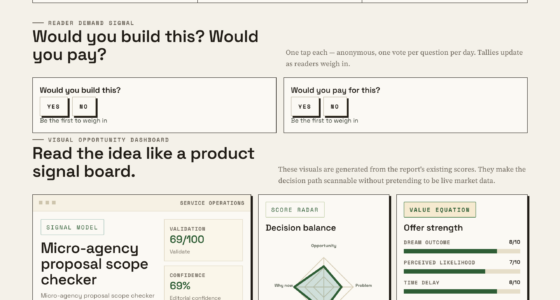

📊 Full opportunity report: How Redirect-Map Insurance Protects Your Ecommerce SEO Investment on IdeaNavigator AI — validation score, market gap, and execution plan.

Get smart everyday buys delivered free with Prime
- Fast, free delivery on millions of items
- Prime Video, Amazon Music and more included
- Member-only deals all year
TL;DR
Redirect-map insurance offers a new solution for ecommerce platforms to safeguard their SEO during migrations. It automates redirect validation, reducing traffic loss. This approach is currently being tested with promising preliminary results.
Redirect-map insurance is emerging as a solution to prevent the significant organic traffic loss that often occurs during ecommerce platform migrations. Currently in testing, this approach aims to automate redirect validation, helping stores preserve their SEO rankings and traffic after switching platforms.
The core challenge in ecommerce platform migrations is maintaining accurate redirect maps, which are critical for preserving organic search rankings. During migration, a broken redirect map can silently cause a 40-80% drop in organic traffic, often only discovered days after launch when rankings have already collapsed. This problem is especially acute as many stores are consolidating onto platforms like Shopify or moving away from legacy carts, increasing the frequency of migrations.
In response, a new tool called redirect-map insurance is being tested. It uses a crawl export or sitemap as input, then applies slug-matching and category-structure logic to draft a redirect map. Before launch, it validates each redirect on a staging URL, and at go-live, performs a paired crawl to flag 404 errors, redirect chains, and orphaned pages within minutes. This process aims to significantly reduce errors that manual QA often misses, which are responsible for most traffic drops.
Marketed as an ecommerce SEO tooling solution, the product is offered through per-migration project pricing and an agency subscription model for repeated use. IdeaNavigator AI reports that initial validation involves offering free redirect-map audits on ten upcoming migrations sourced from ecommerce communities, with early results indicating error detection rates surpassing manual QA efforts.
Impact of Redirect-Map Insurance on Ecommerce SEO Stability
This development is significant because it addresses a persistent pain point for ecommerce stores undergoing platform migrations. By automating redirect validation, it reduces the risk of traffic loss, preserves search rankings, and minimizes revenue impact. Given the high volume of migrations happening as stores consolidate or upgrade, this tool could become a standard part of migration workflows, improving overall SEO resilience.
As an affiliate, we earn on qualifying purchases.
Ecommerce Migrations and SEO Challenges
Platform migrations are a common but risky process for ecommerce stores, especially those with substantial organic traffic. Historically, many stores discover post-migration that their redirect maps were flawed, leading to traffic drops and ranking setbacks. Manual QA processes often fail to catch all errors, making the process vulnerable to significant SEO damage. With the rise of popular platforms like Shopify, and legacy cart deprecations, the frequency of migrations has increased, amplifying the importance of reliable redirect management tools.
Recent industry discussions highlight the need for automated solutions that can validate redirects quickly and accurately, reducing the reliance on manual spreadsheet checks and post-launch troubleshooting. The new redirect-map insurance approach is part of this evolving landscape, aiming to provide a more robust safeguard during these critical transitions.
“Automating redirect validation can drastically reduce the traffic loss associated with platform migrations, saving stores both time and revenue.”
— an anonymous researcher
website migration redirect checker
As an affiliate, we earn on qualifying purchases.
As an affiliate, we earn on qualifying purchases.
Uncertainties in Adoption and Effectiveness
It is not yet clear how widely adoptable the redirect-map insurance tool will become or how effectively it will perform across diverse ecommerce platforms and complex site structures. The initial testing phase is limited, and results are preliminary. Further validation is needed to confirm its ability to prevent traffic loss in varied real-world scenarios.
As an affiliate, we earn on qualifying purchases.
Next Steps for Validation and Industry Adoption
Further testing on a broader set of migrations will determine the tool’s effectiveness and reliability. Ecommerce agencies and stores are expected to trial the solution, with early adopters providing feedback. Industry stakeholders will monitor error detection rates and the impact on post-migration traffic retention. If successful, the tool could become a standard component of migration workflows, with wider availability expected in the coming months.
As an affiliate, we earn on qualifying purchases.
Key Questions
How does redirect-map insurance work?
It uses a sitemap or crawl export to draft redirect maps, validates them on staging URLs, and performs a paired crawl at go-live to identify errors like 404s and redirect chains, all automatically.
What are the main benefits of using redirect-map insurance?
The primary benefits include reducing organic traffic loss, preserving search rankings, and saving time by automating error detection during platform migrations.
Is this tool suitable for all ecommerce stores?
It is designed for stores with meaningful organic traffic undergoing platform migrations. Effectiveness across all site types is still being evaluated.
When will this tool be generally available?
The current phase involves testing and validation. Broader availability is expected after successful validation, likely within the next few months.
What are the limitations of this approach?
Its effectiveness depends on accurate input data and site complexity. It also requires integration into existing migration workflows, which may vary across agencies.
Source: IdeaNavigator AI
Halloween Picks
halloween
As an affiliate, we earn on qualifying purchases.