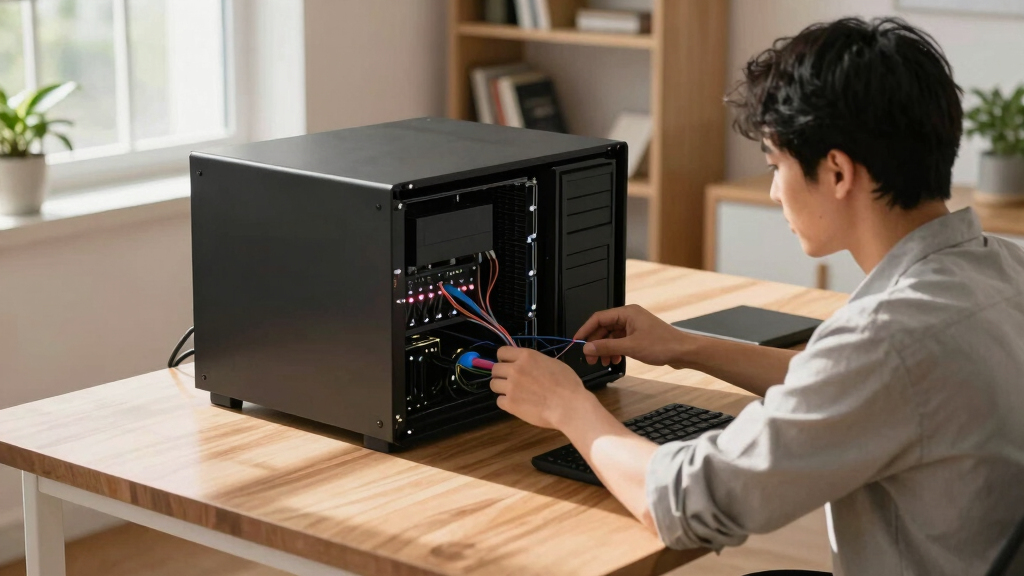

📊 Full opportunity report: The Real Cost Of A Local-Inference Rig In 2026 on ThorstenMeyerAI.com — validation score, market gap, and execution plan.

Get smart everyday buys delivered free — and shop member deals
- Fast, free delivery on millions of items
- Access to Prime Big Deal Days deals on October 6–7
- Prime Video, Amazon Music and more included
TL;DR
In 2026, owning a local AI inference rig involves significant hardware costs, dominated by VRAM capacity. Used GPUs like the RTX 3090 offer better VRAM-per-dollar than newer flagship cards, especially for high-utilization AI tasks. The decision depends heavily on model size and budget.
In 2026, the actual cost of building a local inference rig for AI models is heavily influenced by VRAM capacity, with the most cost-effective solutions often involving used hardware like the RTX 3090. This shift impacts AI practitioners seeking privacy, cost control, and hardware ownership, making hardware selection critical.
The core constraint for local inference in 2026 is the VRAM cliff: models must fit entirely in GPU memory to run efficiently. For instance, a 70-billion-parameter model requires approximately 43GB of VRAM at FP16 precision, making high-end GPUs necessary for larger models.
While the latest flagship GPUs such as the RTX 5090 offer speed advantages, their VRAM-per-dollar ratio is inferior to used older models like the RTX 3090, which can be acquired for around $600–850 and provide 24GB of VRAM. Multiple used 3090s can be pooled via NVLink to handle larger models at a fraction of the cost of new flagship cards.
Model sizing and quantization techniques, such as Q4 compression, enable running larger models on less expensive hardware. For example, 26–32B models fit comfortably within a single 24GB card, making them accessible for local deployment, replacing API calls and reducing ongoing costs.
Hardware tier recommendations vary: entry-level models (7–14B) can run on a $750 RTX 5070 Ti or used 3090; mid-range models (26–32B) on a single 24GB card; high-end models (70B) on an RTX 5090 or multiple 3090s; and very large models (100B+) require multi-GPU setups or large memory Macs. The most cost-effective high-value upgrade is reaching 24GB VRAM, unlocking the entire 26–32B model class.
The real cost of a local-inference rig
Owning beats renting for steady AI work — so what does a local rig cost in 2026? The unintuitive, good news: the most expensive build is almost never the smartest one. It all comes down to one rule.
The difference is only whether the weights fit. LLM inference is memory-bandwidth-bound — VRAM capacity is the hard limit you build around. Compute specs are mostly noise.
The squeeze reframes the rig like everything else in this series: discipline beats maximalism. VRAM is exactly the memory under most pressure, so over-buying it is the 128GB-“to-be-safe” trap, only worse per gigabyte. Take the cheap, high-value step to 24GB (the gateway to the 30B class), reach for used 3090s and MoE models, and use quantization to climb a tier without buying silicon. Sized right, the rig pays for itself against the cloud’s ever-rising hidden bill. Next: Apple Silicon’s quiet memory advantage.
Why Hardware Choices Shape AI Deployment Costs in 2026
Understanding the hardware costs and limitations of local inference rigs in 2026 is vital for AI practitioners and organizations aiming to control expenses and maintain data privacy. The emphasis on VRAM capacity over raw compute speed shifts purchasing strategies toward used GPUs and multi-GPU setups, making AI more accessible outside cloud environments. This impacts the economics of AI deployment, influencing decisions for startups, research labs, and enterprise users.
As an affiliate, we earn on qualifying purchases.
The Evolution of AI Hardware Costs and Strategies
Over the past few years, AI inference hardware has rapidly evolved, with new flagship GPUs offering increasing compute power but diminishing VRAM-per-dollar value. In 2026, the memory bottleneck remains dominant, with inference speed primarily limited by VRAM bandwidth rather than raw processing power. The trend toward quantization and multi-GPU pooling reflects a shift toward maximizing value from older or used hardware, as the high cost of new flagship cards becomes prohibitive for many users.
Previous years saw a focus on compute performance, but now, the ability to fit models in VRAM is the key to practical local inference. This has led to a resurgence in used GPU markets and multi-GPU configurations, which provide a cost-effective alternative to expensive new hardware.
“The high cost of flagship GPUs like the RTX 5090 makes multi-3090 setups the most economical path for large models, especially when pooling VRAM via NVLink.”
— Industry expert on GPU markets
As an affiliate, we earn on qualifying purchases.
Unresolved Questions About Future Hardware and Costs
It remains unclear how rapidly GPU prices will change in 2026, especially for used hardware, and whether new innovations will alter the VRAM-to-cost ratio significantly. Additionally, the long-term viability of multi-GPU setups and the impact of emerging memory technologies are still uncertain.
As an affiliate, we earn on qualifying purchases.
Next Steps for Building Cost-Effective Local AI Rigs in 2026
Practitioners should monitor GPU market trends, especially used hardware prices, and evaluate the evolving landscape of quantization and multi-GPU pooling. Future hardware releases and memory innovations could shift the cost-benefit balance, so staying informed will be essential for optimizing local inference setups.
As an affiliate, we earn on qualifying purchases.
Key Questions
Is building a local inference rig cheaper than cloud options in 2026?
For high-utilization models, especially those fitting within 24GB VRAM, building a local rig with used GPUs like the RTX 3090 can be significantly cheaper over time than ongoing cloud costs.
What is the most cost-effective GPU for local inference in 2026?
Used RTX 3090s offer the best VRAM-per-dollar ratio, especially when pooled with NVLink, making them the preferred choice for many users.
How does quantization affect hardware choices?
Quantization techniques like Q4 enable larger models to run on less expensive hardware, expanding the range of feasible local inference setups.
Will newer flagship GPUs be worth the investment?
Unless specific speed or feature advantages are needed, newer flagship GPUs often do not justify their higher cost given the VRAM-per-dollar advantage of older models.
Can Macs or Apple Silicon hardware handle large models?
Yes, with large unified memory, Apple Silicon chips like the M5 Max can run models comparable to high-end GPUs, offering an alternative path for local inference.
Source: ThorstenMeyerAI.com
Fall Picks
fall essentials
As an affiliate, we earn on qualifying purchases.