
📊 Full opportunity report: How Parents Rehearse IEP Negotiations Without The Pressure on IdeaNavigator AI — validation score, market gap, and execution plan.

Get smart everyday buys delivered free with Prime
- Fast, free delivery on millions of items
- Prime Video, Amazon Music and more included
- Member-only deals all year
TL;DR
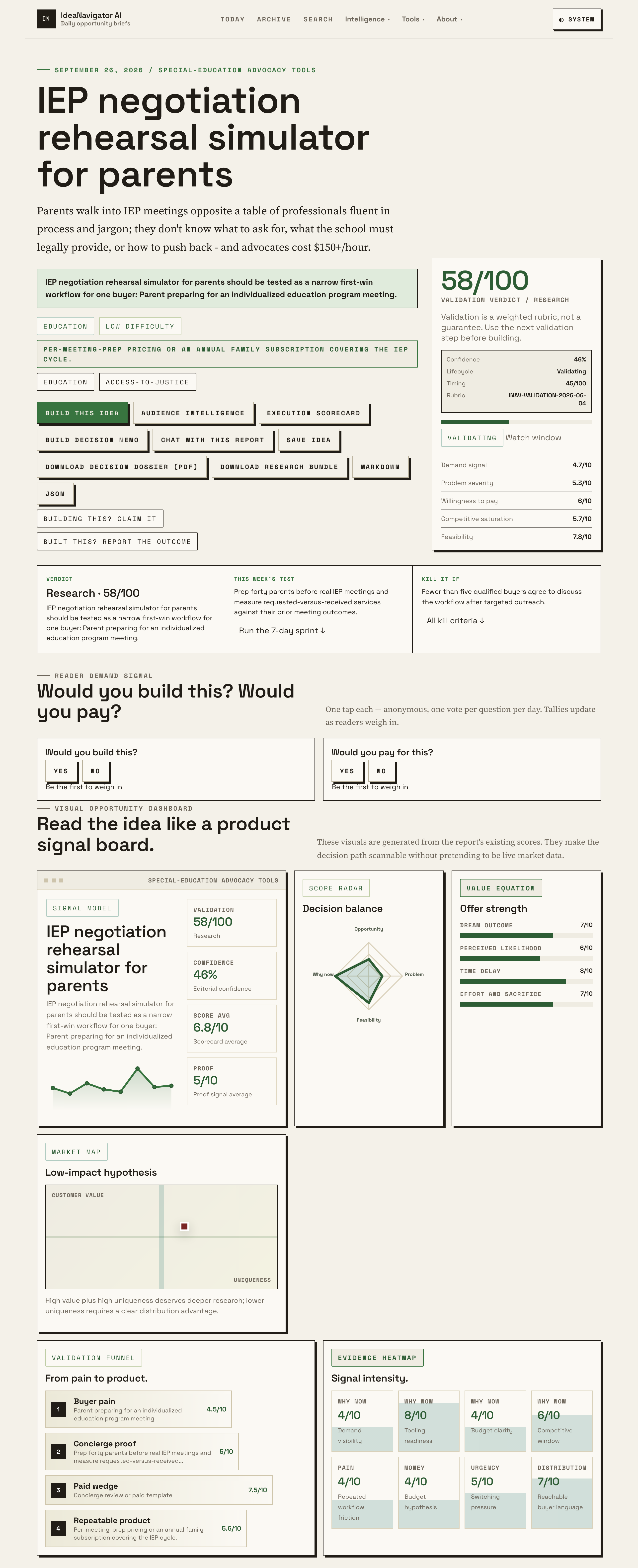
A product concept from IdeaNavigator AI proposes an AI-powered rehearsal simulator that role-plays IEP meetings with parents before the real thing, translating legal entitlements into plain language and drilling negotiation against realistic school-side pushback. The concept is unvalidated and faces a defined test: preparing forty parents for real meetings and measuring whether requested services are won more often than in prior years.
A rehearsal simulator for individualized education program (IEP) meetings has been proposed as a new AI application, one that would let parents practice the negotiation itself before sitting across from a school team. The concept, outlined by IdeaNavigator AI, would have parents upload their child’s current IEP and evaluation reports, receive an explanation of legal entitlements in plain language, and then role-play the meeting repeatedly against an AI that generates realistic pushback until the parent can hold their positions.
The proposal targets a single buyer: a parent preparing for an IEP meeting. The problem it addresses, as framed by IdeaNavigator AI, is an asymmetry at the meeting table. Parents typically sit opposite a group of professionals fluent in special-education process and jargon, and according to the concept write-up, many parents do not know what to ask for, what the school is legally required to provide, or how to push back when requests are declined. Professional advocates who can fill that gap are priced at $150 or more per hour, per the concept document.
The minimum viable product, as described, works in three stages. First, the parent uploads the current IEP and evaluation reports. Second, the simulator explains the child’s entitlements in plain language and generates a request list with legal grounding attached to each item. Third, it role-plays the meeting, including school-side resistance, repeating until the parent can defend each request under pressure.
The proposed business model is per-meeting-prep pricing or an annual family subscription that covers the full IEP cycle. The concept is positioned within the special-education advocacy tools market.
Pressure on Families Is Rising
The concept’s stated timing rationale is twofold. First, large language model role-play has reached a level of quality where a simulated IEP meeting is plausible — something that was not realistic with earlier chatbot technology. Second, according to the concept document, special-education identification rates keep climbing while district resources tighten, a combination that tends to make IEP meetings more adversarial as schools face more demand with constrained budgets.
For families, the stakes in an IEP meeting are concrete: the services, accommodations, and placement decided in that room shape a child’s school year. A tool that lowers the cost of preparation from advocate hourly rates to a subscription could change how many parents arrive prepared. The concept document also argues the tool is deliberately narrow — one buyer, one workflow, one meeting — which is a common early-stage strategy to prove value before expanding.
Top picks for "parent rehearse negotiation"
As an affiliate, we earn on qualifying purchases.
The Advocate Gap Parents Face
IEP meetings are convened under U.S. special-education law to set the educational plan for a student with a qualifying disability. The school side of the table typically includes special-education staff, teachers, and administrators who handle these meetings routinely. Parents, by contrast, may attend one or two such meetings a year and are often encountering the process for the first time.
Professional advocates exist to balance that dynamic, but at $150-plus per hour, according to the concept document, they are out of reach for many families. The proposed simulator would sit between doing nothing and hiring an advocate: cheaper than professional help, more interactive than static online guides, and personalized to the child’s actual documents.
No Evidence Yet of Better Outcomes
The simulator is a concept, not a validated product. IdeaNavigator AI presents it as a candidate for building, and the write-up does not report that any version exists, that any parents have used it, or that any company is developing it.
Several substantive questions remain open. It is not clear how accurately an AI simulator can model a specific district’s behavior, since pushback styles vary by school and state. The concept does not specify how the tool would keep its legal grounding current or handle state-level variation in special-education law, and it does not address whether AI-generated legal explanations would be reviewed by a qualified person. Whether parents who rehearse successfully in a simulation transfer those skills to a real, emotionally charged meeting is untested. The pricing model — per-meeting or subscription — is also undecided.
A Forty-Parent Test Would Decide It
The concept document specifies a validation path: prepare forty parents before real IEP meetings, then compare the services they requested versus what they received against the outcomes of their own prior meetings. That within-family comparison is intended to control for differences between children and districts.
If a builder takes up the concept, the next steps would be assembling the document-upload and role-play pipeline, recruiting the forty-parent cohort, and running the before-and-after measurement. Until that data exists, the simulator remains an unproven idea with a defined test attached.
Source: IdeaNavigator AI
Key Questions
Does this IEP rehearsal simulator exist today?
No. As described by IdeaNavigator AI, it is a product concept with a proposed minimum viable product and validation plan. No working version, user base, or company has been reported.
How would the simulator work for a parent?
According to the concept, a parent would upload the current IEP and evaluation reports, receive a plain-language explanation of entitlements and a request list with legal grounding, and then role-play the meeting against an AI that simulates realistic school-side pushback until the parent can hold their positions.
How much would it cost?
The concept proposes either per-meeting-prep pricing or an annual family subscription covering the IEP cycle. No prices have been set. For comparison, the concept document cites professional advocates at $150 or more per hour.
How would anyone know the simulator actually helps?
The proposed validation is to prepare forty parents before real IEP meetings and compare requested-versus-received services against each family’s prior meeting outcomes. That test has not been run.
Could an AI give wrong legal advice about special education?
That risk is not addressed in the concept document. Special-education law varies by state and changes over time, and it is unclear how the tool would keep its legal grounding accurate or whether any human review would be involved. Parents with complex disputes should still consider qualified legal or advocacy help.
Source: IdeaNavigator AI
Halloween Picks
halloween
As an affiliate, we earn on qualifying purchases.