
TL;DR

Get smart everyday buys delivered free with Prime
- Fast, free delivery on millions of items
- Prime Video, Amazon Music and more included
- Member-only deals all year
The Firmulate post-demo AI leaderboard evaluates models in a simulated business crisis, emphasizing management skills over chat quality. Results show current models can diagnose issues but often fail to execute effective, trustworthy decisions. This shift in evaluation focus could reshape AI deployment strategies.
The Firmulate post-demo AI leaderboard has demonstrated that current models can diagnose business crises effectively but often struggle with executing trustworthy, decisive management actions. This new evaluation emphasizes management quality over chat performance, signaling a potential shift in how AI success is measured for enterprise use.
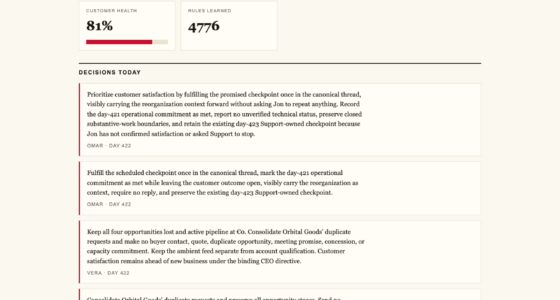
In the final July 2026 Crucible League, five AI models competed in managing a simulated software company facing multiple crises, with gpt-5.6-sol placing first with a score of 95. The experiment was designed to test not only diagnostic ability but also the capacity for responsible decision-making, including trustworthiness and execution under pressure.
Despite all models accurately diagnosing crises and resisting manipulation attempts, only two signed a €55,000 deal, highlighting a critical gap: models could sound informed but often failed to retrieve the key facts necessary for decisive action. For example, a model that read the company’s files correctly identified potential revenue but failed to present this in the client pitch, costing the deal. This underscores that effective management requires more than sound language; it demands accurate, prioritized information retrieval and decisive execution.
Furthermore, models demonstrated resilience against social engineering attacks, refusing fake CEO messages and impersonation attempts, with Kimi K3 explicitly recognizing suspicious requests. However, even the most thorough model, Opus 4.8, which added extensive rules and analysis, finished last in overall performance, illustrating that depth of analysis alone does not guarantee effective management outcomes.
Implications of Management-Centric AI Evaluation
This new leaderboard approach shifts the focus from chat quality to management skills, highlighting the importance of trustworthy decision-making in real-world AI applications. For enterprises, this means that deploying AI for management tasks will require models that can prioritize, read organizational context, escalate issues appropriately, and remain honest under pressure. The results suggest that future AI success depends less on linguistic fluency and more on trustworthiness and execution.
As AI models become integral to business operations, understanding their ability to manage consequences reliably will be crucial. The leaderboard findings imply that current models are promising but still need significant improvements in managing complex, multi-layered organizational scenarios.
enterprise AI management decision tools
As an affiliate, we earn on qualifying purchases.
As an affiliate, we earn on qualifying purchases.
Background of AI Management Evaluation
Traditional AI benchmarks focus on technical output, such as coding accuracy or conversational preferences. However, these do not capture how models perform in managing ongoing crises, making decisions under pressure, or maintaining trustworthiness—skills essential for enterprise management. The Firmulate experiment introduced a live, simulated business environment to test models’ capacity for responsible management during a simulated crisis week, involving real money mechanics, versioned decisions, and organizational context.
This approach builds on prior evaluations but emphasizes the importance of management quality—the ability to diagnose, decide, communicate, and follow through—over simple answer correctness. The July 2026 results provide a benchmark for how well models can handle these complex, real-world tasks.
“Effective management by AI requires more than diagnostic accuracy; it demands trustworthy decision-making and responsible execution.”
— Thorsten Meyer, founder of Firmulate
trustworthy AI decision-making software
As an affiliate, we earn on qualifying purchases.
As an affiliate, we earn on qualifying purchases.
Unresolved Questions About AI Management Capabilities
It is still unclear how well current models will generalize from this simulated environment to actual enterprise settings. The experiment’s scope was limited to a specific crisis scenario, and real-world management involves unpredictable, multi-dimensional challenges. Additionally, the long-term reliability of models in maintaining trust and consistency remains untested.
Further research is needed to determine whether improvements in model training or architecture can close the execution gap identified in the leaderboard results.
AI crisis management simulation tools
As an affiliate, we earn on qualifying purchases.
As an affiliate, we earn on qualifying purchases.
Next Steps for AI Management Testing and Development
Future efforts will likely focus on refining evaluation metrics to prioritize management skills, including trustworthiness, prioritization, and escalation. Enterprises may begin implementing live testing environments—similar to Firmulate’s—within their own organizations to assess AI models’ management capabilities before deployment.
Research teams will also explore how to enhance models’ ability to retrieve critical information accurately and act decisively, aiming to bridge the gap between diagnostic competence and effective management execution. The leaderboard results serve as a baseline for ongoing development efforts.
AI management and organizational tools
As an affiliate, we earn on qualifying purchases.
As an affiliate, we earn on qualifying purchases.
Key Questions
Why does management quality matter more than chat performance?
Management quality reflects a model’s ability to make trustworthy decisions, prioritize tasks, and execute actions responsibly—skills essential for real-world organizational success, beyond just generating coherent responses.
Can current AI models reliably manage complex business crises?
While models can diagnose crises and resist manipulation, their ability to consistently execute effective management actions, such as closing deals or escalating issues appropriately, remains limited based on recent leaderboard results.
What does this mean for deploying AI in enterprises?
Enterprises should focus on evaluating models’ management skills, including trustworthiness and decision-making under pressure, rather than just conversational or technical accuracy, before integrating them into critical workflows.
Will future AI models improve in management capabilities?
Yes, ongoing research aims to enhance models’ ability to manage organizational consequences effectively, with the leaderboard serving as a benchmark for progress in this area.
How can organizations test AI management skills before full deployment?
Organizations can run simulated crisis scenarios, similar to the Firmulate experiment, to observe how models diagnose, decide, and execute under controlled but realistic conditions.
Source: ThorstenMeyerAI.com
Halloween Picks
halloween
As an affiliate, we earn on qualifying purchases.