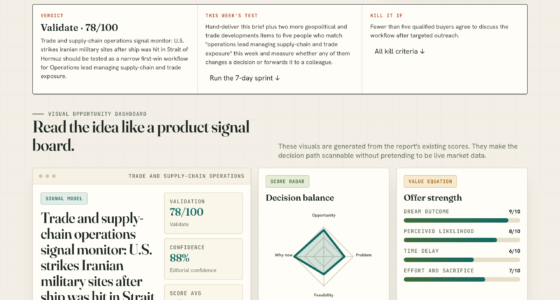

📊 Full opportunity report: Ukraine’s Innovative AI Tactics In The Battle Against Russia’s Amazon on ThorstenMeyerAI.com — validation score, market gap, and execution plan.

Get smart everyday buys delivered free with Prime
- Fast, free delivery on millions of items
- Prime Video, Amazon Music and more included
- Member-only deals all year
TL;DR
Ukraine has launched a series of targeted strikes on Russia’s Wildberries logistics hubs, disrupting its supply network. The operation leverages advanced AI tactics to focus on key infrastructure, aiming to impair Russia’s decentralized procurement and civilian economy.
Ukraine has begun a series of targeted drone strikes on Wildberries logistics facilities across Russia, aiming to disrupt the platform’s role as a decentralized supply network that supports both civilian commerce and military procurement. These strikes, which started on July 18, have damaged or destroyed over 1.18 million square meters of warehouse space, according to satellite imagery reviewed by Reuters. The operation marks a strategic shift in Ukraine’s tactics, leveraging advanced AI and intelligence to target critical infrastructure that facilitates Russia’s war effort and civilian economy.
Since July 18, Ukraine has conducted near-nightly drone attacks on Wildberries logistics hubs across Russia, focusing on key warehouses linked to the platform, Russia’s largest online marketplace. These strikes have damaged significant portions of warehouse capacity, with at least 20 sites affected by August 7, as reported by Reuters. The targeted facilities are not just retail centers; they are critical nodes in a vast, decentralized supply chain that supports Russian military logistics, including procurement of tactical gear, drones, and electronic components.
Ukraine’s operational focus appears to be on disrupting the availability of military and civilian supplies by targeting the backbone of Russia’s online commerce infrastructure. The campaign aims to make acquiring and distributing essential materials more difficult, thereby creating friction in Russia’s supply chain. This approach is underpinned by the use of AI and satellite imagery analysis to identify high-value targets and optimize strike effectiveness.
Additionally, the strikes are affecting Russia’s civilian economy, as Wildberries handles goods worth approximately 3% of Russia’s total economic output. Damage to warehouses impacts thousands of independent sellers, leading to inventory losses, delayed shipments, and financial strain on small businesses. Ukrainian officials have stated that their focus is on impairing supply chains that support Russia’s war effort, even if not all strikes target military-specific equipment directly.
Since 18 July, Ukrainian drones have hit ~20 Wildberries logistics sites. It looks like an odd target — until you see that one strike can hit three systems at once: the battlefield supply chain, the civilian economy, and the banks.
Wildberries is a consumer marketplace, a national logistics network, a decentralised military-supply channel, and an increasingly important node in Russia’s banking system. Hit a warehouse and the cost propagates outward.
Strategic Impact of Disrupting Russia’s Decentralized Supply Network
This campaign represents a significant shift in Ukraine’s warfare strategy, employing AI and precision strikes to target the logistical backbone of Russia’s economy and military procurement. By focusing on the infrastructure that enables decentralized military supply and civilian commerce, Ukraine aims to create systemic friction, reducing Russia’s ability to sustain its war effort and maintain economic stability. The operation underscores the evolving role of AI in modern conflict, enabling more targeted and efficient strikes that can have widespread ripple effects across supply chains and civilian livelihoods.
warehouse drone surveillance camera
As an affiliate, we earn on qualifying purchases.
As an affiliate, we earn on qualifying purchases.
Background of Ukraine’s Use of AI and Cyber Tactics in the War
Since the onset of the conflict in February 2022, Ukraine has increasingly integrated advanced technology and cyber tactics into its military operations. Notably, Ukraine’s use of AI for intelligence gathering and target identification has grown, allowing for more precise strikes on logistical hubs and military assets. The recent focus on Wildberries logistics facilities marks a strategic evolution, targeting the infrastructure that facilitates Russia’s hybrid war approach—combining conventional military actions with economic and cyber warfare.
Previous operations have included cyberattacks on Russian networks and infrastructure, as well as physical strikes on military targets. The current campaign is distinguished by its emphasis on decentralization and the use of AI-driven analysis to identify high-value logistical nodes within Russia’s civilian commerce network, which also serve military logistics.
"We are targeting the backbone of Russia’s supply chain to weaken their war effort and disrupt their civilian economy."
— Ukrainian Defense Official
As an affiliate, we earn on qualifying purchases.
Unclear Scope and Future of Ukraine’s Targeting Strategy
It is not yet clear how long Ukraine will continue these strikes or whether the campaign will expand to other logistical nodes. The precise role of AI in target selection and strike optimization remains partially undisclosed, and the full impact on Russia’s military procurement and civilian economy is still being assessed. Additionally, Russia’s response and potential countermeasures are not yet known.
As an affiliate, we earn on qualifying purchases.
Expected Developments in Ukraine’s Disruption Campaign
Ukraine is likely to continue targeting Wildberries logistics hubs, employing AI to refine target selection and increase strike precision. Monitoring will focus on the extent of damage to Russia’s supply chain, potential retaliatory actions, and the broader impact on Russia’s economy and military logistics. Further strikes may target additional warehouses or related infrastructure, with the campaign possibly expanding to other logistical networks supporting Russian military operations.
As an affiliate, we earn on qualifying purchases.
Key Questions
How is Ukraine using AI in these strikes?
Ukraine employs AI for satellite imagery analysis and target identification, enabling precise strikes on key logistical hubs that support Russia’s military and civilian supply chains.
What is the significance of targeting Wildberries logistics?
Wildberries functions as a decentralized supply network that supports both civilian commerce and military procurement, making it a strategic target to disrupt Russian logistics and economy.
Are these strikes causing long-term damage?
While the strikes have caused significant physical damage, the long-term impact depends on the ability of Russia to repair and adapt its logistics network. Ukraine aims to create ongoing friction and supply chain disruptions.
Could Russia retaliate against Ukraine’s infrastructure?
Potential retaliatory actions are possible, but specific plans or targets have not been publicly disclosed. The ongoing campaign indicates a focus on economic and logistical disruption rather than direct military confrontation.
Is Ukraine’s use of AI legal under international law?
The legality of Ukraine’s AI-driven tactics is not fully established and depends on evolving international norms regarding cyber warfare and targeted strikes. Ukraine states its operations are defensive and aimed at impairing military logistics.
Source: ThorstenMeyerAI.com
Evergreen bestsellers Picks
bestsellers
As an affiliate, we earn on qualifying purchases.