
TL;DR

Get smart everyday buys delivered free with Prime
- Fast, free delivery on millions of items
- Prime Video, Amazon Music and more included
- Member-only deals all year
IdeaClyst is a local-first, AI-driven platform that acts as a war room for founders. It combines structured council debates, real-time research, and a founder workspace to accelerate validation and decision-making, keeping all data private on your machine.
Ever stared at a blank screen, wondering which idea to chase next? You’re not alone. Most founders juggle multiple concepts, feeling the weight of choosing wrong. The build part is easy—thanks to modern tools, shipping code is lightning-fast. The real challenge? Picking the right idea and sticking with it. That’s where a war room comes in—except this one lives in your laptop.
Imagine a space where your ideas get brutally honest feedback, where conflicting opinions clash to reveal the truth, and where your decision gets backed with real research. That’s the promise of IdeaClyst. It’s more than just a tool; it’s your personal strategy HQ. Ready to see how it can sharpen your focus and supercharge your confidence? Let’s dive in.
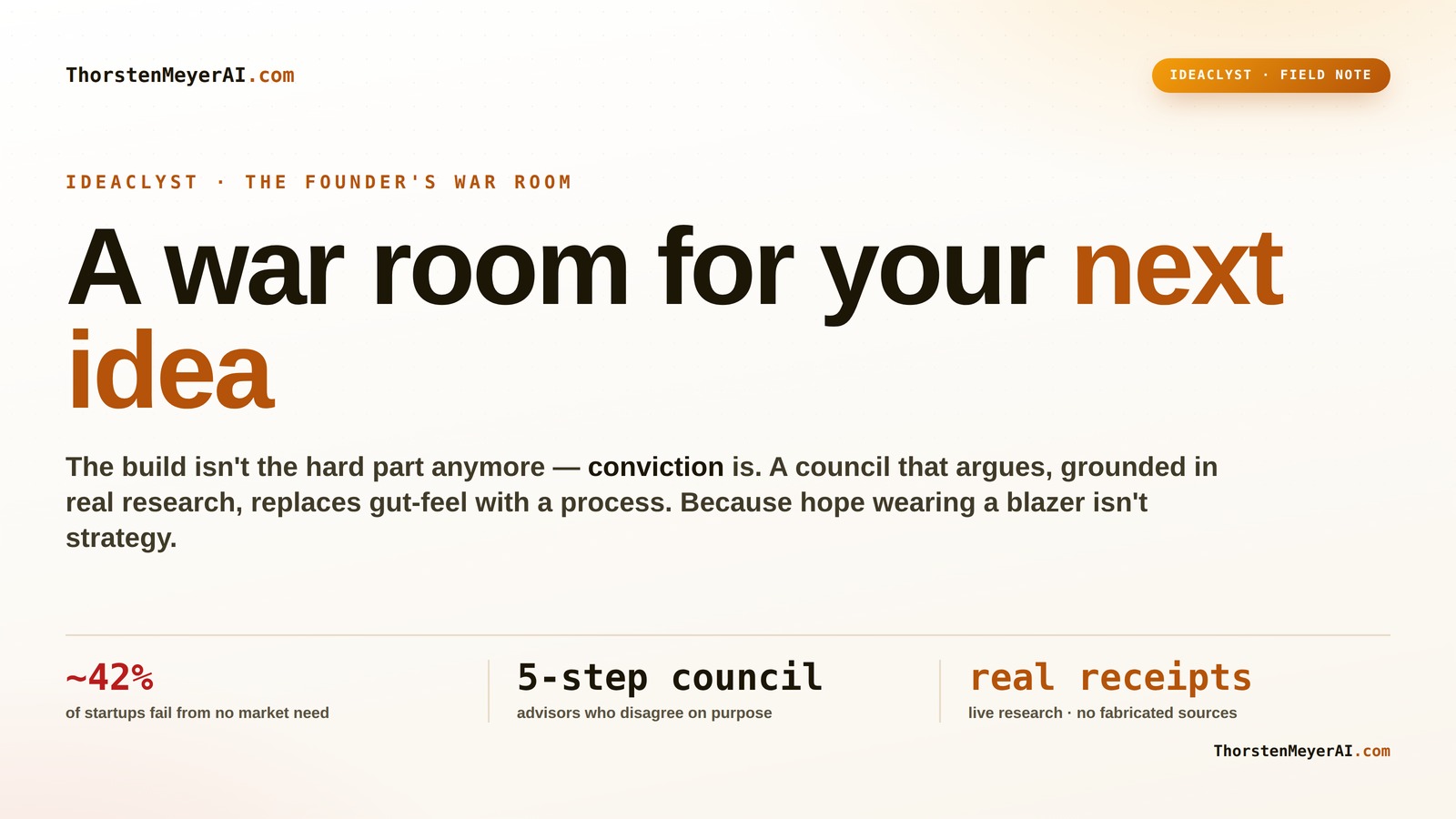
A war room for your next idea
The build isn’t the hard part anymore — conviction is. Knowing which idea deserves the next six months, and being able to defend it. Most founders answer with gut feel and optimistic math. That’s hope wearing a blazer. IdeaClyst replaces it with a process.
The most expensive decision is what to build
The single most valuable thing a tool can do is talk you out of the wrong six months. The numbers make the case better than any pitch.
Three tools in one — on your own machine
Strip away the framing and IdeaClyst is three things at once, all running locally with nothing leaving your laptop.
An AI council
Pressure-tests an idea you bring it — advisors who argue on purpose.
A discovery engine
Finds ideas you didn’t know to look for by hunting real demand signals.
A founder’s workspace
Carries winners from “interesting” all the way to “ready to build.”
Advisors who disagree on purpose
Not one confident, agreeable answer — a structured five-step deliberation where models play different roles and turn on their own work. The disagreement is the feature.
The five-step deliberation
A council that leads with the bad news surfaces the objections you’d otherwise find the expensive way, on month five.
Product strategy
Who’s it for, what’s the wedge, why now, what’s the business model.
Technical architecture
What would it actually take to build — and where’s the risk.
Critique pass
The council turns on its own work. Where’s the hand-waving? What kills this?
Second, independent critique
A different voice, a different angle — so blind spots don’t survive.
Final synthesis
Everything into one coherent founder packet: strategy, architecture, validation, plan.
When IdeaClyst cites a source, it actually fetched it
The hard departure from “ask an AI what it thinks of my startup.” It runs in a strict, real-data-only mode — if it can’t gather genuine evidence, it says so plainly rather than inventing a plausible paragraph.
Confidence with receipts
No fabricated statistics, no imaginary competitors, no made-up citations. The packet survives a skeptical co-founder or a sharp investor because the reasoning has receipts.
Market research first
Scouts the landscape before the council reasons about anything.
Competitor read
Real positioning, pricing signals, feature claims — differentiation vs. reality.
Validation with links
Not “talk to customers” — concrete signals & sources you can click.
From the blank page to build-ready
Evaluation is half the problem; the blank page is the other half. And a plan is worthless if it dies in a tab you never reopen.
Bring a space, not an idea
“AI for accountants,” “tools for indie game studios” — plus your goal and real capacity. It hunts demand signals across HN, Reddit, Product Hunt, GitHub, pricing pages.
- An honest market read — leads with the bad news when a space is hard
- An opportunity map — high pain, thin competition
- Ranked candidates — wedge, who pays, effort, risk, confidence
- each with KILL CRITERIA — when to walk away
A home and a forward path
Every promising idea gets carried forward, with every artifact in plain files on your disk.
- Validation tooling — sprint board, interview list, evidence browser
- Founder profile — a personal-fit lens; same discovery, different advice
- Build workspaces — funnel, personas, landing draft, version history
- “Build this idea” → a PRD + task queue, ready for a coding agent
Key Takeaways
- A structured AI council debate in IdeaClyst surfaces flaws early, reducing costly mistakes.
- Grounding ideas in real-time web research avoids reliance on vague market assumptions.
- A digital war room like IdeaClyst keeps your ideas private, organized, and accessible without clutter.
- Consistency in updating and reviewing your war room turns it into a strategic advantage.
- Choose digital, physical, or hybrid setups based on your team’s needs for maximum flexibility.
Products Worth Considering

Apple iPad Air 11-inch (M2), 512GB, Wi-Fi, Space Gray

FLEXISPOT 32-Inch Electric Standing Desk Converter with Keyboard Tray

LG UltraGear 27-Inch QHD OLED Gaming Monitor, 240Hz, 0.03ms, G-SYNC Compatible, FreeSync Premium Pro, HDMI 2.1
As an affiliate, we earn on qualifying purchases.
What Is a War Room and Why Does It Matter for Your Ideas?
A war room is a dedicated space—physical or digital—where teams focus intensely on a project or challenge. Think of it as your command center, with whiteboards, sticky notes, charts, and now, powerful AI tools. For founders, it’s a place to test ideas, spot flaws, and align quickly. Learn more about war rooms.
In a startup, the stakes are high. A survey from CB Insights shows that 42% of failures happen because there’s no market need. Building something nobody wants costs thousands each month. A war room condenses months of validation into days, making sure your idea is worth the effort before you ship.
With IdeaClyst, the war room moves online, keeping everything private and on your own machine. It’s like having a strategic war council that argues, debates, and refines your idea before you commit. That clarity can save you hundreds of thousands and years of wasted effort.
How IdeaClyst Turns Your Idea Into a Debate Between Multiple AI Advisors
IdeaClyst isn’t just one AI giving you a warm, fuzzy answer. It stages a debate—five structured steps where different models play roles like strategist, engineer, and critic. Each one challenges your idea from a different angle, exposing blind spots. Discover how AI debates improve ideas.
For example, you pitch it a new SaaS idea. The strategy advisor asks, “Who’s your customer? Why now? What’s the unique angle?” Meanwhile, the technical advisor questions, “How hard is this to build? What are the risks?” Next, a critic points out assumptions that might be wrong—like, maybe the market isn’t big enough.
Then, a second critic from a different perspective questions further. Finally, all these voices synthesize into a clear plan—highlighting strengths, weaknesses, and next steps. This structured argument prevents you from falling for wishful thinking and makes your plan bulletproof.
Why Grounding Ideas in Real Web Research Beats Vibes and Gut Feelings
Many founders rely on gut feelings or vague market assumptions. But IdeaClyst grounds every recommendation in live web research, pulling in current data, trends, and facts. It’s like having a real-time market analyst whispering in your ear.
For instance, if you’re thinking about a telehealth app, IdeaClyst scans recent news, competitor launches, and user feedback to tell you if the market is truly growing or just hype. It’s not about vague phrases like “market is expanding” but solid numbers and recent events.
According to recent studies, 60% of startup failures could have been avoided with better market validation. IdeaClyst compresses that validation from months of research into hours, giving you confidence that your idea isn’t just wishful thinking but backed by current facts.
Designing Your Digital War Room: Walls, Tools, and Focus
A great war room is a clutter-free zone where ideas flow and focus sharpens. Inside IdeaClyst, the workspace is your digital whiteboard, full of structured sections—strategy, critique, validation plan, and research notes—all saved as Markdown files on your disk.
Imagine a clean interface where your team’s ideas are laid out like a battlefield map. Use color-coded notes for assumptions, risks, and action items. Keep the space flexible—add or remove sections as your idea matures.
For physical spaces, think big whiteboards, sticky notes, and minimal distractions. For digital setups, use large screens or dedicated apps. The key? Make it visual, accessible, and distraction-free.
Physical, Digital, or Both? Choosing Your War Room Setup
Deciding between a physical or digital war room depends on your team size, location, and workflow. Digital war rooms like IdeaClyst offer instant access, version control, and privacy—perfect for remote or hybrid teams. Physical spaces excel in collaboration and spontaneous discussion.
For example, a remote startup might use IdeaClyst as its central hub, with team members adding insights from anywhere. Meanwhile, a local team could set up a dedicated whiteboard room for face-to-face brainstorming.
Many teams find a hybrid approach best: digital for documentation, physical for quick sprints. The goal is to keep ideas flowing, visibility high, and distractions low.
Using Your War Room Every Day: From Brainstorming to Building
Consistency turns a war room from a cluttered mess into a strategic powerhouse. Inside IdeaClyst, you can run daily standups, update hypotheses, track validation tests, and review progress—all in one place.
Picture your team gathered around a big screen, each member adding notes, flagging risks, or updating the plan. Over time, your war room becomes a living document—shaped by real-time feedback and data.
For example, during a new feature rollout, your team can use the space to document user feedback, update validation tests, and pivot quickly if needed. This keeps everyone aligned and moves ideas from concept to market faster.
Avoiding the Clutter Trap: Keep Your War Room Focused and Productive
A common mistake is turning your war room into a dumping ground for every idea or task. Keep your focus sharp. Inside IdeaClyst, structure sections clearly—strategy, critique, validation—so nothing gets lost in the noise.
For instance, dedicate a specific area for assumptions, another for risks, and a third for next steps. Regularly review and prune outdated notes to keep the space lean and actionable.
Remember, a cluttered war room hampers clarity. Clear boundaries and disciplined updates make sure your space works for you, not against you.
Your Questions Answered: War Room Basics and Best Practices
- What is a war room, exactly? A dedicated space—physical or digital—for intense focus, collaboration, and decision-making on a project or idea.
- Do I need a physical room? Not necessarily. Digital options like IdeaClyst offer privacy, flexibility, and instant access, making physical space optional.
- What should go on the walls or boards? Key assumptions, risks, validation tasks, progress updates, and visual timelines.
- How big should it be? Big enough to see everything at a glance. For digital, a clean, organized interface works best. For physical, a large whiteboard or wall is ideal.
- How do I keep it organized? Use sections, color coding, and regular clean-ups. Discipline prevents clutter from hiding the real issues.
Frequently Asked Questions
What is a war room, exactly?
A war room is a dedicated space—physical or digital—designed for intense focus, collaboration, and quick decision-making on a project or idea. It helps teams see progress and stay aligned.Can I use a digital war room instead of a physical one?
Absolutely. Digital war rooms like IdeaClyst offer privacy, instant access, and flexibility, especially for remote or hybrid teams. They can be just as effective as physical spaces if set up well.What should I put on the walls or in my digital space?
Use sections for key assumptions, risks, validation steps, and progress notes. Visuals like charts, color coding, and timelines help keep everything clear and actionable.How often should I update my war room?
Daily or weekly, depending on your project. Regular updates turn it into a living document that evolves with your idea, helping you stay focused and adapt quickly.Is a war room only for big projects?
Not at all. Small teams or solo founders can benefit just as much, using it to clarify their vision, validate assumptions, and stay disciplined in their approach.Conclusion
Think of your next idea as a battleground—and your war room as the command center that keeps you sharp. With IdeaClyst, you get a private, flexible, AI-driven space where conflicting voices challenge your assumptions and ground decisions in real data. That’s how founders turn uncertain guesses into confident strategies.
Your best idea is waiting—set up your war room today, and watch your confidence and clarity grow. After all, the future belongs to those who prepare for it.