
📊 Full opportunity report: Purchase order exception tracker for small manufacturers on IdeaNavigator AI — validation score, market gap, and execution plan.

Get smart everyday buys delivered free with Prime
- Fast, free delivery on millions of items
- Prime Video, Amazon Music and more included
- Member-only deals all year
TL;DR
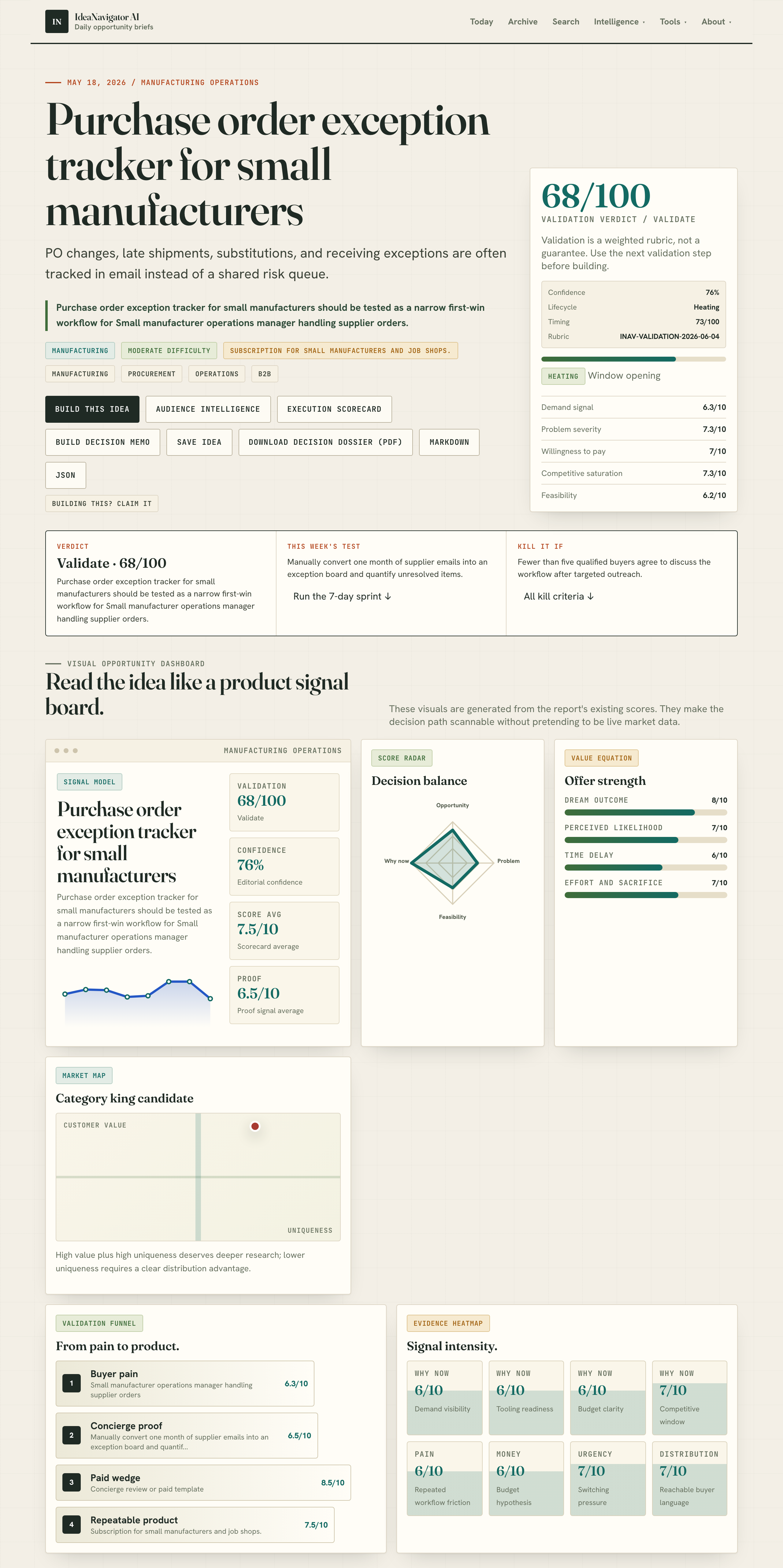
A prototype purchase order exception tracker is being tested for small manufacturers to streamline handling supplier issues. The tool aims to replace email-based tracking, addressing supply chain challenges. Its success will depend on initial validation efforts.
A prototype purchase order exception tracker designed for small manufacturers is set to undergo initial testing, aiming to improve how operations managers handle supplier issues amid rising supply chain volatility.
The proposed solution is an exception board that records key details such as supplier, purchase order number, issue type, responsible owner, next action, and notes on customer impact. It is intended as a lightweight, shared workflow tool to replace email-based tracking of PO changes, late shipments, substitutions, and receiving exceptions.
According to sources familiar with the project, the tracker is being developed as a minimum viable product (MVP) with the goal of validating its effectiveness through a practical test. This involves manually converting one month of supplier emails into the exception board to measure unresolved issues and assess workflow improvements.
The initiative targets small manufacturers and job shops, with a subscription model proposed as the primary revenue stream. The market focus is on manufacturing operations, where supply disruptions are increasingly costly for small teams with limited resources.
Potential Impact on Small Manufacturing Supply Chains
This development could significantly improve how small manufacturers manage supplier issues, reducing reliance on email and manual tracking, which are prone to oversight. If successful, it may lower operational costs and improve responsiveness during supply disruptions, which are becoming more frequent due to global supply volatility.
Enhanced tracking could lead to faster issue resolution, better communication with suppliers, and more reliable production schedules, ultimately strengthening small manufacturers’ competitiveness in a challenging environment.
Products Worth Considering

Logitech MX Keys S Wireless Keyboard, Graphite

Logitech MX Brio Ultra HD 4K Webcam, Graphite

FLEXISPOT 60-Inch Executive Standing Desk with Drawers and CPU Cabinet
As an affiliate, we earn on qualifying purchases.
Rising Supply Chain Volatility and Manual Tracking Challenges
Small manufacturers often handle supplier issues through email correspondence, which can lead to overlooked problems and delayed responses. Supply chain disruptions, intensified by recent global events, have increased the cost and complexity of exception management for these firms.
The idea of a dedicated exception tracker emerges amid this context, aiming to streamline workflows and reduce the inefficiencies associated with manual email tracking. The concept has gained traction as a practical first step, with validation efforts underway to confirm its effectiveness.
“Replacing email-based tracking with a shared exception board could reduce unresolved issues and improve response times for small manufacturers.”
— an anonymous researcher
Uncertainties About Tracker Effectiveness and Adoption
It is not yet confirmed how well the exception tracker will perform in real-world small manufacturing environments. The validation process, involving manual data conversion and issue quantification, is still ongoing, and results are not yet available.
Additionally, it remains unclear how quickly small manufacturers will adopt the new tool and whether it will integrate smoothly with existing workflows.
Next Steps for Validation and Broader Deployment
The immediate next step is to complete the manual conversion of one month of supplier emails into the exception board and analyze unresolved issues. Based on these results, developers will refine the MVP and plan broader testing.
If validation proves successful, a phased rollout to additional small manufacturers will follow, along with potential feature enhancements based on user feedback.
Key Questions
How will the exception tracker improve current workflows?
It will centralize and streamline tracking of supplier issues, replacing email chains with a shared, organized dashboard, which can improve response times and reduce unresolved problems.
Who is the target user for this tool?
Small manufacturing operations managers responsible for handling supplier orders and resolving issues related to PO changes, late shipments, or substitutions.
What is the plan for validating the tracker?
The plan involves manually converting one month of supplier emails into the exception board to measure unresolved issues and assess workflow improvements before broader deployment.
Will this be a paid service?
Yes, the tracker is intended to be offered via a subscription model aimed at small manufacturers and job shops.
When can users expect broader availability?
Broader deployment will depend on initial validation results, with potential rollout planned after successful testing and refinement.
Source: IdeaNavigator AI