
TL;DR

Get smart everyday buys delivered free with Prime
- Fast, free delivery on millions of items
- Prime Video, Amazon Music and more included
- Member-only deals all year
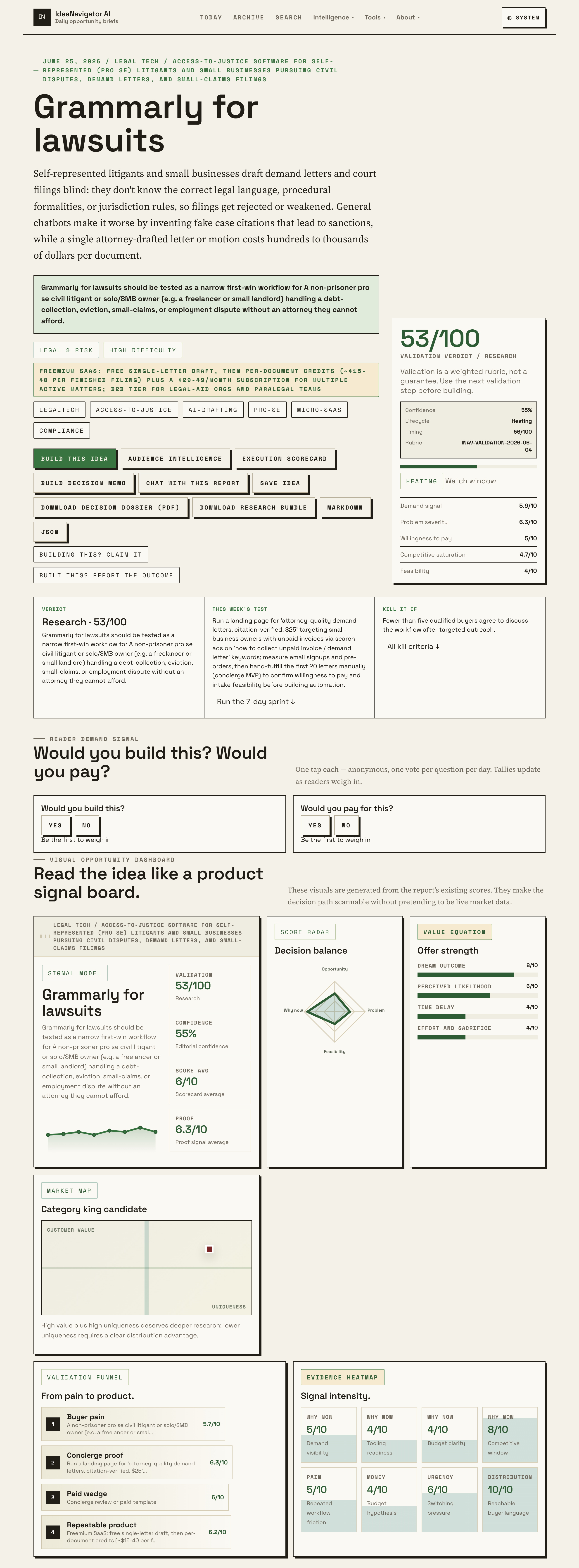
A new AI-driven web application is being developed to help self-represented litigants and small businesses draft legally accurate, court-formatted demand letters and filings. It verifies citations and ensures procedural compliance, addressing a critical gap in civil justice access.
A new AI-powered platform is being developed to assist self-represented litigants and small business owners in drafting court-formatted, citation-verified legal documents. This tool aims to address the widespread challenges faced by non-lawyers in civil disputes, offering a streamlined workflow that ensures procedural correctness and legal accuracy, which is critical for increasing access to justice.
The platform focuses initially on a narrow but high-impact use case: drafting demand letters and small-claims filings for debt collection, eviction notices, or employment disputes. Users input structured details such as parties involved, amounts, contract facts, and jurisdiction, and the system generates a legally formatted document ready for e-signature and filing. The core innovation is a ‘lawsuit Grammarly’ pass that flags weak or missing elements, verifies every cited statute or case against a real legal database, and blocks hallucinated or incorrect citations.
According to sources involved in the project, the tool aims to reduce errors common among pro se litigants, who often lack legal training and rely on generic chatbots or unverified templates that can lead to case rejection or sanctions. The system’s citation verification feature is designed to prevent the proliferation of hallucinated case law or statutes, which have become an increasing concern in courts, especially with the rise of AI-generated legal documents. The product will be offered as a freemium SaaS, with a free draft per user and paid options for multiple documents or subscription plans, targeting small businesses, legal aid organizations, and individual litigants.
Implications for Self-Represented Litigants and Small Businesses
This development could significantly improve the quality and legality of documents drafted by non-lawyers, reducing rejection rates and sanctions, and potentially lowering legal costs. As roughly 60% of civil cases in the U.S. now involve pro se parties, enhancing their capacity to produce court-compliant filings can increase access to justice and reduce the burden on courts. The citation verification feature addresses a growing concern: the widespread use of AI language models that often hallucinate legal citations, leading to sanctions and case delays. If successful, this tool could set a new standard for AI-assisted legal drafting, emphasizing verification and procedural accuracy.
legal document drafting software for small businesses
As an affiliate, we earn on qualifying purchases.
As an affiliate, we earn on qualifying purchases.
Growing Need for Verified AI Legal Drafting Tools
Over the past decade, the number of pro se litigants in U.S. civil courts has steadily increased, driven by the high costs of legal representation and limited access to affordable legal services. Between 2000 and 2019, approximately 27% of federal civil cases involved at least one pro se party, a figure that continues to rise. Meanwhile, the proliferation of AI language models has introduced new risks: many AI-generated legal documents contain hallucinated citations, which can lead to sanctions, case dismissals, or unfavorable judgments. This has created an urgent demand for tools that not only generate legal documents but also verify their accuracy and procedural compliance.
Current solutions, such as generic chatbots, lack the ability to verify citations or format documents according to court rules, limiting their utility for self-represented parties. Legal tech startups and organizations have begun exploring specialized AI tools that focus on verification and formatting, but few have successfully integrated citation validation at scale. The proposed platform aims to fill this gap by combining structured intake, document generation, and real-time verification against authoritative legal databases.
“This tool could dramatically reduce the error rate among pro se filings, which currently hampers access to justice and increases court workloads.”
— an anonymous researcher
court-formatted demand letter templates
As an affiliate, we earn on qualifying purchases.
As an affiliate, we earn on qualifying purchases.
Unresolved Challenges and Development Risks
It is not yet clear how effectively the citation verification will perform against complex or obscure legal references, or how courts will receive AI-generated filings that are fully verified. The project is still in early prototype testing, and real-world validation with users and courts remains pending. Additionally, regulatory and legal acceptance of AI-assisted filings is evolving, and there may be unforeseen legal or procedural hurdles that could affect adoption.
As an affiliate, we earn on qualifying purchases.
Upcoming Milestones and Deployment Plans
The development team plans to conduct pilot testing of the prototype with small-business owners and legal aid organizations in late 2024. They aim to gather user feedback, refine citation verification accuracy, and test the document formatting against various court standards. Following successful testing, the platform could be launched publicly in early 2025, with initial focus on demand letters and small-claims filings. Further integration with court filing systems and expansion to other document types are expected in subsequent phases.
As an affiliate, we earn on qualifying purchases.
Key Questions
How will the citation verification work?
The system will cross-reference all cited statutes and case law against a real legal database, flagging any discrepancies or hallucinated references before finalizing the document.
Can this tool replace a lawyer?
No, it is designed to assist self-represented litigants and small businesses by improving document accuracy and compliance. It does not replace legal advice or representation.
Will courts accept documents generated by this tool?
This depends on court acceptance of AI-generated filings. The platform aims to produce court-formatted, verified documents that meet procedural standards, but legal acceptance will vary by jurisdiction.
What types of disputes will it support?
Initially, the focus will be on demand letters, debt collection, eviction notices, and small-claims filings involving straightforward legal issues.
How much will the service cost?
The basic draft will be free, with paid options ranging from $15-40 per document and monthly subscriptions of $29-49 for multiple matters, targeting affordability for small users.
Source: IdeaNavigator AI
Columbus Day / Indigenous Peoples' Day Picks
long weekend sales
As an affiliate, we earn on qualifying purchases.