
📊 Full opportunity report: How To Build Consent Workflows For Kid-Facing Vendors on IdeaNavigator AI — validation score, market gap, and execution plan.

Get smart everyday buys delivered free with Prime
- Fast, free delivery on millions of items
- Prime Video, Amazon Music and more included
- Member-only deals all year
TL;DR
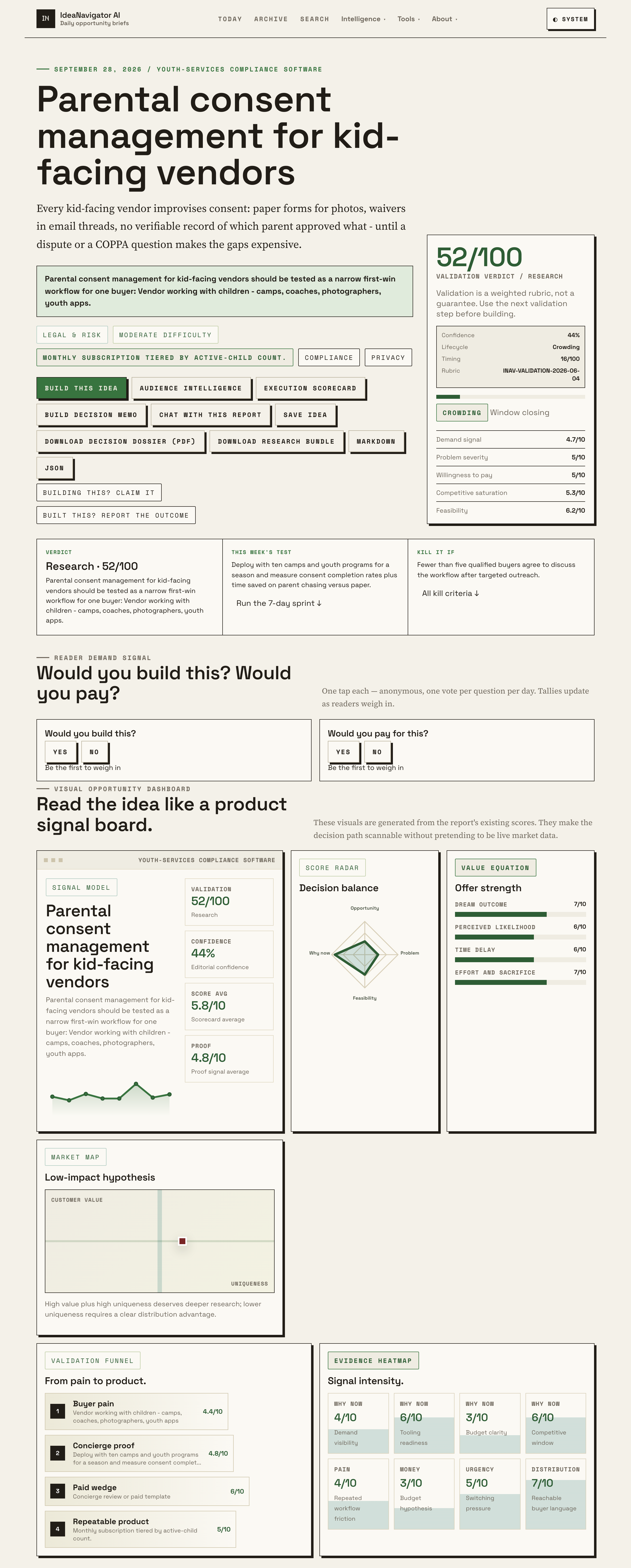
IdeaNavigator AI has published a product blueprint for parental consent management aimed at camps, coaches, photographers and youth apps. It proposes phone-based consent flows with per-child ledgers, expiry tracking and audit exports, monetized through monthly subscriptions tiered by active-child count. The plan calls for validation with ten camps over a season before scaling.
IdeaNavigator AI has published a product blueprint urging developers to build parental consent management workflows for small kid-facing vendors — camps, coaches, photographers and youth apps — arguing that improvised paper forms and email waivers leave these businesses exposed as children’s privacy enforcement expands. The blueprint positions consent management as a narrow, achievable first product for a single buyer type rather than a broad compliance platform.
According to the blueprint, the core problem is that nearly every vendor working with children handles consent informally: photo releases on paper, liability waivers buried in email threads, and no verifiable record of which parent approved what. The gaps become expensive, it argues, only when a dispute arises or a regulator raises a COPPA question. The federal Children’s Online Privacy Protection Act imposes consent and data-handling duties on services directed at children, and updated COPPA rules plus new state privacy laws have widened the exposure, according to the analysis.
The proposed minimum viable product is a set of vendor-branded consent flows that parents complete on their phones, covering photo use, data collection, medical authorization and liability. The design calls for identity verification scaled to risk tier, a per-child consent ledger, expiry tracking so outdated permissions surface automatically, and instant audit export for disputes or regulatory requests. Revenue would come from a monthly subscription tiered by active-child count, placing the product in the youth-services compliance software market.
Validation is deliberately modest: the blueprint recommends deploying with ten camps and youth programs for a single season and measuring consent completion rates and time saved chasing parents, compared against paper-based processes.
Why Small Youth Vendors Are the Target
The blueprint targets a segment that enterprise compliance tools typically ignore: small camps, solo coaches and independent photographers who lack legal teams but face the same questions from parents and regulators. If the premise holds, verifiable consent records would shift these vendors from improvised paperwork to defensible documentation — useful in photo-use disputes, medical situations and regulatory inquiries alike.
The framing also matters for builders. IdeaNavigator AI presents this as a narrow first-win workflow, not a platform play — a deliberately small scope intended to reach revenue and demonstrated results quickly. The subscription model tied to active-child count aligns cost with a vendor’s seasonal scale, which matches how camp and youth-program enrollment fluctuates.
The Enforcement Backdrop Driving Demand
The blueprint’s timing argument rests on two converging pressures. First, children’s privacy enforcement is expanding: COPPA updates and state-level privacy laws have increased the number of rules that touch services and vendors dealing with minors’ data. Second, according to the analysis, parents are increasingly likely to challenge how photos and personal information about their children are used, pushing even very small vendors toward record-keeping they previously never needed.
Against that backdrop, the traditional toolset — paper forms, emailed waivers, spreadsheets — creates a record that is hard to verify after the fact. The proposed per-child consent ledger and audit export are designed to answer the question that arises in disputes: who consented, to what, and when.
What the Blueprint Hasn’t Proven Yet
The blueprint is a proposal, not a validated business. No pilot results are cited; the ten-camp validation it recommends has not been run, so consent completion rates and time savings are unknown. It is also unclear how much parents will tolerate identity-verification steps on their phones, or what verification level satisfies regulators across different consent types — the blueprint says only that verification should match the risk tier, without specifying how tiers are defined.
Questions about legal defensibility also remain open. The analysis does not cite regulator guidance or case law confirming that a vendor-side consent ledger would satisfy COPPA or state-law requirements in any particular scenario, and it does not address how the product would handle custody disputes or conflicting parental instructions. Pricing levels and willingness to pay among small vendors are likewise unstated.
The Ten-Camp Season Test
According to the blueprint’s own validation plan, the immediate next step is a single-season deployment with ten camps and youth programs, measuring consent completion rates and the time saved chasing parents compared with paper. Those results would determine whether the workflow merits broader development. For vendors and builders watching the space, the practical markers to watch are pilot completion data, any pricing the developers publish, and whether COPPA or state enforcement actions begin reaching small offline vendors as the blueprint predicts.
Source: IdeaNavigator AI
Key Questions
Who is the proposed consent workflow for?
It targets small vendors working with children — camps, coaches, photographers and youth apps — who currently manage photo, data, medical and liability consent through paper forms and email.
What would the product actually include?
Per the blueprint: vendor-branded phone-based consent flows, identity verification matched to risk tier, a per-child consent ledger, expiry tracking and instant audit export, sold as a monthly subscription tiered by active-child count.
Why is this being proposed now?
IdeaNavigator AI points to expanding children’s privacy enforcement — COPPA updates and state laws — plus parents increasingly challenging photo and data use, which pushes small vendors toward defensible consent records.
Has the idea been tested?
No. The blueprint recommends validation with ten camps and youth programs over a season, measuring completion rates and time saved. No pilot results have been published.
Would a consent ledger satisfy COPPA requirements?
That is unclear. The blueprint does not cite regulator guidance or case law confirming that its approach would satisfy COPPA or state privacy laws in specific scenarios.
Source: IdeaNavigator AI
Halloween Picks
halloween
As an affiliate, we earn on qualifying purchases.