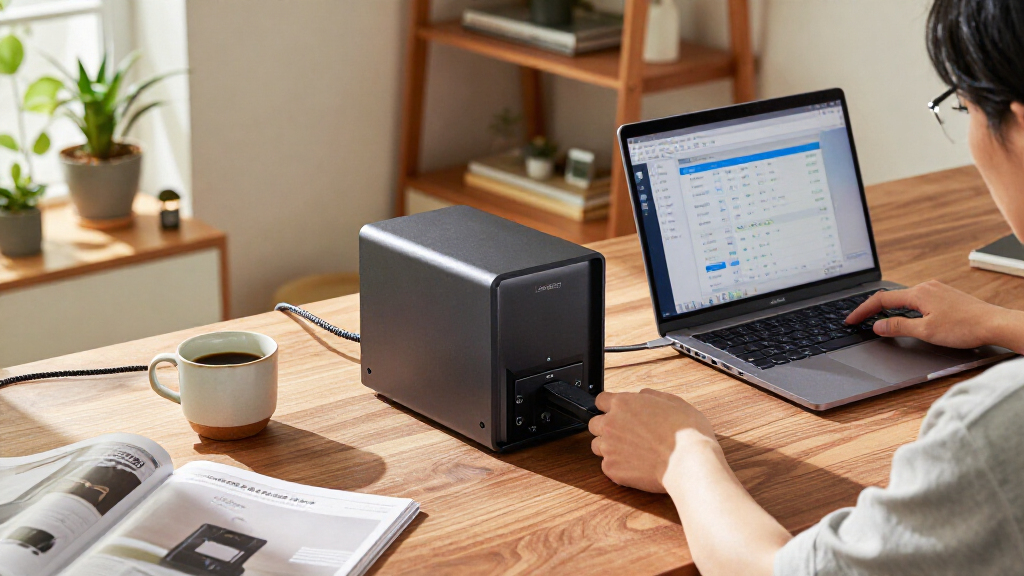

🔍 Read the full analysis: How To Compare The UGREEN NAS DXP4800 Pro With AI Storage Alternatives on ThorstenMeyerAI.com

Get smart everyday buys delivered free with Prime
- Fast, free delivery on millions of items
- Prime Video, Amazon Music and more included
- Member-only deals all year
TL;DR
The UGREEN NAS DXP4800 Pro pairs four drive bays, an Intel Core i3-1315U, expandable DDR5 memory and 10GbE networking with on-device AI photo organization. Those specifications may suit home-lab users and small teams, but the stated 144TB capacity depends on separately selected drives, and the source provides no direct benchmark against AI-storage competitors.
The UGREEN NAS DXP4800 Pro combines a four-bay enclosure, an Intel Core i3-1315U processor, expandable memory and 10GbE networking with on-device AI photo organization, positioning it as a flexible home server rather than a basic backup box. The listed specifications may appeal to people running self-hosted services or moving large files, but they do not establish that it outperforms competing AI-enabled storage products; the supplied comparison material offers no head-to-head benchmark or competitor AI feature test.
The DXP4800 Pro has four 3.5-inch drive bays and two PCIe 4.0 M.2 slots. Its stated ceiling of up to 144TB depends on the drives installed across the bays and slots; the source does not state that drives are included. Buyers must budget for storage separately and choose a configuration suited to capacity and data-protection needs.
UGREEN lists an Intel Core i3-1315U with six cores and eight threads, 8GB of DDR5 memory, and memory expansion up to 96GB. The system supports Docker and virtual machines, and UGOS Pro includes media, photo and cloud-sync tools. The source says its photo tools can organize images using on-device AI, but supplies no accuracy, speed or privacy testing for that feature.
Networking includes 10GbE and 2.5GbE, with a stated maximum transfer speed of 1.25GB/s. That figure is a product specification, not a guarantee of real-world performance: computers, switches, cabling, drives and workload must all support the faster path. The package also lists tool-free drive trays and a two-year warranty; no long-term reliability or noise evidence is provided.

UGREEN NAS DXP4800 Pro 4-Bay Network Attached Storage
- ✔ Processor: Intel Core i3-1315U, 6 cores, 8 threads, up to 4.5GHz
- ✔ Memory: 8GB DDR5, expandable to 96GB
- ✔ Graphics: 13th Gen Intel UHD Graphics
The 1 picks
- 1
 UGREEN NAS DXP4800 Pro 4-Bay Desktop NAS with Intel Core i3-1315U, 8GB DDR5,…View on Amazon →
When AI NAS Hardware Pays Off
The comparison matters because “AI storage” can describe very different products: a NAS that runs photo organization locally, a device built around cloud features, or a conventional storage appliance with software extras. The provided material confirms that the DXP4800 Pro offers on-device AI photo organization, but it does not show how that function compares with alternatives in recognition quality, supported formats, processing time or ongoing software support. Buyers should treat the AI label as a feature to test against their own workflow, not as proof of superior capability.
The stronger case for this model is its combination of drive capacity, network options and server flexibility. A small creative team, home-lab user or household with a large media library may value room for multiple drives and the ability to run services alongside file sharing. Someone who only needs backups and shared folders could pay for processing power and faster networking they will not use. The source names Synology’s DS223 and DS223j as simpler two-bay alternatives, but does not provide equivalent specifications or prices for a full comparison.
Performance also depends on the surrounding setup. A 10GbE port cannot speed up a transfer beyond the limits of a gigabit client connection or switch, and the listed 144TB capacity requires purchased drives. The practical cost therefore includes more than the NAS enclosure: it may include drives, compatible network equipment, setup time and a separate backup plan. RAID options can help preserve access after some drive failures, but RAID is not a substitute for backup.
Hardware, Software and Alternatives
The DXP4800 Pro sits above basic two-bay NAS devices in the product description supplied. Four bays give buyers more room to add drives and choose among listed RAID 0, 1, 5 or 10 configurations. The two M.2 slots offer further SSD capacity. These are hardware options, not a promise that every configuration will deliver the same performance or usable capacity; RAID layout and installed drives affect both.
Its processor and memory support are relevant to workloads beyond file storage. Docker containers and virtual machines can consolidate self-hosted services on one device, while memory expansion may help when several services run together. That flexibility has limited value for buyers who only want automatic backups. The included 8GB of DDR5 is the stated starting point; the source recommends considering an upgrade for setups with several virtual machines but provides no workload benchmarks.
UGREEN’s UGOS Pro software is described as including media, photo and cloud-sync features, alongside AI-assisted photo organization. The source does not identify named rival AI-storage products or document their capabilities, pricing, data handling or support periods. A reliable comparison therefore starts with needs and verified product documentation rather than assuming that products carrying an AI label offer equivalent functions.
What the Specifications Do Not Show
The supplied material does not establish how the DXP4800 Pro’s AI photo organization performs against features in other NAS products. It gives no direct comparison of recognition accuracy, processing speed, supported file types, local data handling or software updates. It also does not name specific AI-storage alternatives beyond mentioning the simpler Synology DS223 and DS223j as conventional two-bay options.
Pricing, drive inclusion, usable capacity under different RAID layouts and real-world transfer results are not provided. Nor does the source offer independent reliability testing, measured noise levels or long-term support details. The listed two-year warranty is a product detail, but it cannot establish how a unit will perform over time. Buyers should check the current listing and manufacturer documentation for package contents, compatibility and software terms before purchasing.
Checks Before Choosing a NAS
Before buying, compare the DXP4800 Pro with alternatives on the tasks that matter: local photo organization, backup workflow, user access, supported applications, storage expansion and software support. Confirm whether the AI feature operates locally and whether it handles the buyer’s photo library as expected. The source material does not report a new launch or upcoming product milestone, so the next useful step is verification rather than waiting for a stated announcement.
Buyers should also price the full setup, including drives, any required 2.5GbE or 10GbE network equipment, and an independent backup destination. Check drive compatibility and plan usable capacity around the chosen RAID configuration. For a simple backup appliance, compare the total cost and setup demands with a two-bay model; for self-hosted services or large transfers, confirm that the processor, memory and network can serve the intended workload.
Key Questions
Does the UGREEN DXP4800 Pro include drives?
The supplied source does not say that drives are included. Its 144TB maximum depends on installed drives, so check the product listing and budget for storage separately.
What does AI do on the DXP4800 Pro?
The source says UGOS Pro can organize photos using on-device AI. It provides no benchmark or detailed description of accuracy, supported formats or processing speed.
Will the 10GbE port make my home network faster?
Not by itself. To benefit from the port’s speed, the client device, switch, cabling and storage must support a compatible 10GbE connection. Otherwise, another part of the network can limit transfers.
Who is the DXP4800 Pro best suited to?
Based on the listed features, it may suit home-lab users, creators and small teams that can use multiple drive bays, self-hosted services or faster networking. A two-bay NAS may be a more suitable fit for basic backups and shared folders.
Does RAID replace a separate backup?
No. RAID configurations can help maintain access after some drive failures, but they do not replace a separate backup. Keep an independent copy of important files.
Source: ThorstenMeyerAI.com