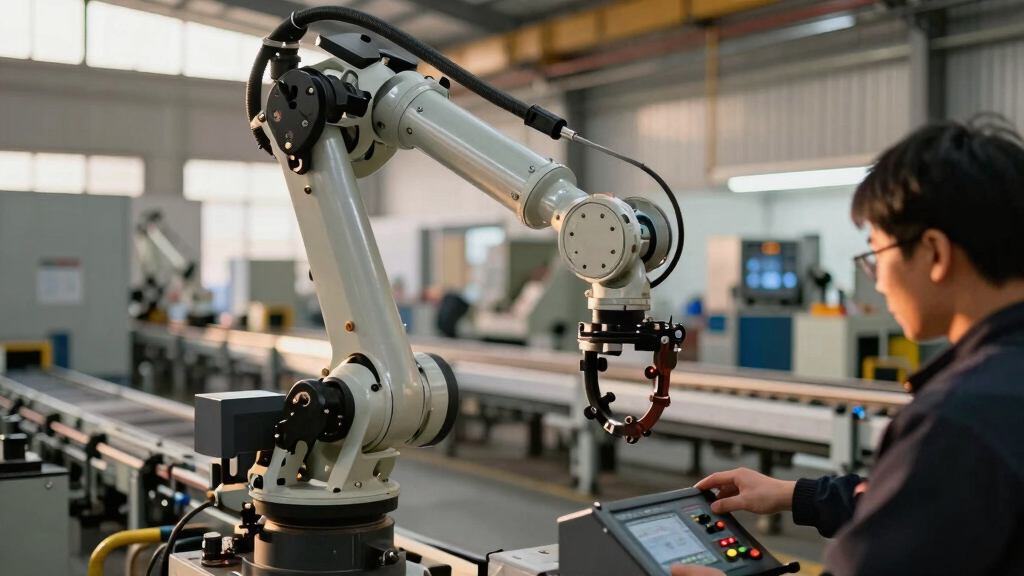

The Machine Economy — Capital-Heavy, Human-Light, Trading With Itself

📊 Full opportunity report: The Machine Economy — Capital-Heavy, Human-Light, Trading With Itself on ThorstenMeyerAI.com — validation score, market gap, and execution plan.

TL;DR

The ‘machine economy’ is emerging as AI-native firms dominate markets, operating with high capital and minimal human involvement. This shift is driven by AI’s ability to automate business functions, leading to economic bifurcation and new governance challenges.

Recent analysis indicates that a new economic paradigm, termed the ‘machine economy,’ is emerging, characterized by AI-driven firms that operate with minimal human labor and high capital investment in compute infrastructure. This development, discussed by Thorsten Meyer and Jack Clark, signals a fundamental shift in how businesses are structured and compete, with profound implications for labor, inequality, and governance.

The concept of the machine economy describes a future where AI systems, capable of performing AI engineering and business operations, lead to the creation of autonomous firms. These firms are capital-heavy, owning extensive compute infrastructure, and human-light, relying on AI for decision-making across functions such as finance, legal, marketing, and supply chain management. The transition occurs in stages: starting with AI augmentation within human-led firms, then moving to AI-native firms competing alongside traditional companies, and ultimately culminating in fully autonomous corporations that operate without human intervention.

According to Thorsten Meyer, this shift will significantly alter market dynamics, with AI-native firms trading more with each other than with human-led companies. As AI capabilities improve, operational decisions will be made on machine timescales, making human participation nominal. The eventual outcome could be fully autonomous firms legally owned by humans but operated entirely by AI, raising questions about economic inequality, tax bases, and governance. Clark warns that this transition will exacerbate existing issues of inequality and pose new governance challenges, though the precise timing and full implications remain uncertain.

The Machine Economy — Capital-Heavy, Human-Light, Trading With Itself
DISPATCH / MAY 2026 CLARK SERIES · 4 OF 5 · THE MACHINE ECONOMY
▲ Clark Series 04 Machine Economy · Post-Labor · May 2026
Clark’s Third Implication · The Structural Endpoint

Capital-heavy.
Human-light.
Trading with itself.

The 200 words Jack Clark spent on his third implication contain the most consequential structural argument in Import AI #455.

Clark’s three numbered implications get progressively less attention. The third — “the formation of a capital-heavy, human-light economy” — receives roughly 200 words. Those 200 words describe an economy that emerges within the existing economy, populated by AI-run corporations interacting more with each other than with humans. This is the post-labor economics thesis arriving on the Clark timeline.

Human labor · cognitive function
$50,000per agent-year · US fully loaded
~5,000× cost ratio
AI labor · same cognitive function
$1-10per agent-year · inference compute
~5,000×
Cost ratio · human vs AI labor
Cognitive functions · current frontier models
$500B+
Compute capex · 2024-2027 announced
NVIDIA + hyperscalers + frontier labs
~55%
Labor share of US national income
The tax base the machine economy erodes
32mo
Window · machine economy emergence
Clark forecast · May 2026 → end-2028
5,000× COST RATIO AI LABOR VS HUMAN LABOR · COGNITIVE FUNCTIONS · DISPOSITIVE COMPETITIVE DYNAMICS STAGE 2 BEGINNING AI-NATIVE FIRMS COMPETING ALONGSIDE HUMAN-HEAVY FIRMS · 2026-2029 STAGE 3 PROJECTED MACHINE-TO-MACHINE ECONOMY · AI-RUN CORPORATIONS · 2028-? $500B+ COMPUTE CAPEX 2024-2027 · GEOGRAPHIC CONCENTRATION · COMPUTE AS NEW LAND TAX BASE EROSION LABOR SHARE OF GDP DECLINES · CURRENT FISCAL FRAMEWORKS BREAK POLITICAL ECONOMY CAPITAL CONCENTRATION + AUTOMATED LABOR = UNRESOLVED REDISTRIBUTION PROBLEM 5,000× COST RATIO AI LABOR VS HUMAN LABOR · COGNITIVE FUNCTIONS · DISPOSITIVE COMPETITIVE DYNAMICS STAGE 2 BEGINNING AI-NATIVE FIRMS COMPETING ALONGSIDE HUMAN-HEAVY FIRMS · 2026-2029
Three stages · the transition is not a single event

Three stages. Different equilibria.

The transition from current-state economy to machine economy is staged. Each stage has different structural properties and different policy implications. The 32-month window Clark’s forecast implies is roughly the duration of the Stage 2 transition.

The three stages of the machine economy
Transition is not synchronized across sectors — software / finance / marketing move first, physical-world sectors slower.
▶ Stage 01
2023 – 2026 · current
AI as productivity tool inside human firms
AI augments humans in existing companies. Software engineers use Copilot, Claude Code. Lawyers use Harvey. Marketers use AI copy gen. Firm structure unchanged — humans decide, AI augments output. Labor displacement signal in junior cohorts is the first departure from pure augmentation.
Current stateMost of the AI economy lives here
▶ Stage 02
2026 – 2029 · beginning
AI-native firms compete alongside
New firms designed AI-native. 80% compute / 20% human labor where incumbent is 20%/80%. Comparable services at materially lower prices and faster cadences. Existing firms restructure or get displaced. The Anthropic-SpaceX compute deal is part of the infrastructure that makes this feasible.
Tipping pointWhere the transition accelerates
▲ Stage 03
2028 – ? · projected
Machine-to-machine economy
AI-native firms interact primarily with other AI-native firms. Procurement, contracting, settlement happen on machine timescales. Human economy still exists but is no longer the productive primary — it’s the consumption layer. Fully autonomous corporations as the endpoint.
EndpointThe post-labor economics thesis arrives
Stage 3 is the structural endpoint of automated AI R&D. The default scenario if alignment gets solved.
What Clark doesn’t say · five structural features
ENTERPRISE AI INFRASTRUCTURE: Modern MLOps, Vector Databases, GPU Clusters, and Scalable Data Architecture for LLMs (The Enterprise AI Architect’s Handbook)

ENTERPRISE AI INFRASTRUCTURE: Modern MLOps, Vector Databases, GPU Clusters, and Scalable Data Architecture for LLMs (The Enterprise AI Architect’s Handbook)

As an affiliate, we earn on qualifying purchases.

As an affiliate, we earn on qualifying purchases.
Five additions. Five unresolved problems.

Clark’s 200 words are correct as far as they go. They don’t go far enough. Five structural features deserve explicit treatment that the essay omits. Each one is a real coordination problem with no current solution at scale.

What Clark omits · what serious analysis must include
Each is a structural feature of the machine economy with no resolved policy solution.
01
Compute as the new land
Machine economy runs on compute. Supply is geographically concentrated (US South + West, Ireland, Singapore, UAE). $500B+ capex commitment 2024-2027. Structural equivalent of land in pre-industrial / oil in mid-20th-century economies. Countries with frontier compute capture upside; others become dependent consumers.
02
The tax base erodes
Modern fiscal systems fund services through income taxation. Labor share = 55-60% of GDP. If AI substitutes for cognitive labor, labor share declines and tax base erodes — exactly as demand for transition support rises. Capital-share income is taxed at lower effective rates. New fiscal frameworks required.
03
Transition is self-reinforcing
Cost asymmetry compounds with capital allocation asymmetry compounds with talent allocation asymmetry compounds with customer preference. Once tipping point is reached, transition accelerates rather than decelerates. Historical pattern in structural-significance transitions: long slow runway, then rapid sectoral reorganization.
04
Agentic infrastructure doesn’t yet exist
For Stage 3 machine-to-machine economy, AI corporations need infrastructure that doesn’t fully exist: programmable contracts, machine-readable corporate registries, AI-to-AI escrow, crypto-native settlement. Being built but isn’t ready. Stage 3 timing depends on infrastructure timing as much as on capability timing.
05
Political economy of redistribution unresolved
Small fraction owns capital generating most output. Rest of population without economic function generating income. What political arrangement reconciles capital ownership with majority political power? UBI, capital endowments, sovereign wealth funds, sectoral protection — options exist; none implemented at scale on Clark’s timeline.
Why the transition is self-reinforcing · four compounding dynamics
ZIG NETWORK PROGRAMMING: A Complete Professional Guide to Building High-Performance Network Applications from First Principles (Zig Programming)

ZIG NETWORK PROGRAMMING: A Complete Professional Guide to Building High-Performance Network Applications from First Principles (Zig Programming)

As an affiliate, we earn on qualifying purchases.

As an affiliate, we earn on qualifying purchases.

Four dynamics. Same direction.

The bifurcation between machine economy and human economy is not stable in equilibrium. Once it begins, the competitive dynamics reinforce the transition rather than slowing it. Four asymmetries compound on each other.

The four compounding asymmetries
Each asymmetry drives capital and talent toward AI-native firms while raising barriers for human-heavy competitors.
▲ Asymmetry 01 · Cost structure
Lower costs → lower prices or higher margins
AI-native firms have materially lower costs. Translates to either lower prices (gaining market share) or higher margins (gaining capital for reinvestment). Either path: faster growth than human-heavy competitors.
▲ Asymmetry 02 · Capital allocation
Cheaper capital → faster growth
Investors observe cost asymmetry and rationally direct capital toward AI-native firms. AI-native firms get cheaper capital, lower cost of growth, justification for further allocation. Capital markets reinforce operational asymmetry.
▲ Asymmetry 03 · Talent allocation
Skilled workers follow growth
Workers observe which firms are growing. They move to AI-native firms. AI-native firms get better human talent on top of their AI labor. Human-heavy firms lose talent. Talent market reinforces capital and operational asymmetries.
▲ Asymmetry 04 · Customer preference
Cheaper / faster / better → customers shift
As AI-native firms offer products that are cheaper, faster, or better, customers shift purchasing toward them. Customer preferences, once shifted, accelerate transition further. The fourth reinforcing loop closes.
What policy needs to do · six required responses
Claude Code & Cursor Mastery Handbook (2026): Build Autonomous AI Software Systems with Agentic Workflows, Multi-Agent Architectures, and Production-Ready Pipelines

Claude Code & Cursor Mastery Handbook (2026): Build Autonomous AI Software Systems with Agentic Workflows, Multi-Agent Architectures, and Production-Ready Pipelines

As an affiliate, we earn on qualifying purchases.

As an affiliate, we earn on qualifying purchases.

Six responses. One election cycle.

Current policy frameworks are not calibrated to the machine economy transition. Required responses cluster around six themes. Each is being worked on somewhere; none is on Clark’s 32-month timeline at scale. This is a coordination problem with very high stakes and very short timelines.

Six policy responses the machine economy requires
Required institutional capacity exceeds what current frameworks support on the Clark timeline.
▲ 01 · INFRASTRUCTURE
Compute supply governance
Compute as strategic infrastructure. Allocation rules, public investment, antitrust scrutiny of concentration, geographic distribution policy. Treat compute the way industrial economies treated oil and pre-industrial economies treated land.
▲ 02 · FISCAL
Tax base reform
New tax instruments calibrated to capital-share income and machine-economy outputs rather than labor income. International coordination required to prevent capital flight. Compute tax, AI revenue tax, capital allocation tax — all conceptually clean, all politically difficult.
▲ 03 · LABOR
Transition support
Reskilling, income support, healthcare continuity for displaced workers. Funded from capital-share taxation rather than labor-share taxation. Demand rises as transition accelerates; current institutional capacity is poorly equipped for required scale.
▲ 04 · REDISTRIBUTION
Redistribution mechanisms
UBI, universal capital endowments, sovereign wealth fund models. Norway pilot working; UAE and Saudi explicitly building for AI era. Pilot programs scaling to national implementations on the Clark timeline. Politically difficult but increasingly serious discussion.
▲ 05 · CORPORATE
Machine-economy governance
Legal frameworks for AI-run corporate entities. Liability rules. Antitrust analysis of machine-to-machine market dynamics. Existing corporate law assumes humans make decisions. The assumption breaks in Stage 3. New frameworks required.
▲ 06 · INTERNATIONAL
Coordination across borders
OECD-level framework for capital taxation. WTO-level framework for compute trade. Bilateral and multilateral agreements on AI policy alignment. Required because machine economy is borderless and capital is mobile. International institutional capacity is the weakest link.

The machine economy is the default scenario. The alignment problem is the catastrophic-risk scenario. Both deserve serious attention. Both are arriving on the same timeline.

— The structural read · May 2026
AI IN BUSINESS - AN EXECUTIVE GUIDE FOR BEGINNERS: Leverage Artificial Intelligence to Simplify Automation, Improve Data-Driven Decisions, Maximize ROI and Elevate Customer Experience

AI IN BUSINESS – AN EXECUTIVE GUIDE FOR BEGINNERS: Leverage Artificial Intelligence to Simplify Automation, Improve Data-Driven Decisions, Maximize ROI and Elevate Customer Experience

As an affiliate, we earn on qualifying purchases.

As an affiliate, we earn on qualifying purchases.

Impacts of the Capital-Heavy, Human-Light Shift

The emergence of a machine economy could reshape global markets by concentrating economic power within AI-native firms that require minimal human labor. This may lead to increased economic bifurcation, where traditional firms struggle to compete, and could accelerate inequality, tax base erosion, and shifts in employment. Additionally, fully autonomous firms raise complex governance and regulatory questions, as current legal frameworks are not designed for entities operated entirely by AI systems. Understanding this transition is crucial for policymakers, businesses, and workers as the economy evolves.

Development Timeline of the Machine Economy

The concept of the machine economy builds on recent trends in AI development, where AI systems have transitioned from augmentation tools to autonomous operators. Since 2023, AI has been primarily used to enhance human-led firms, but projections indicate that by 2026-2029, AI-native firms will begin to dominate markets. This evolution aligns with forecasts of rapid AI capability growth, especially in AI engineering and business operations functions, leading to the rise of fully autonomous firms by the late 2020s.

Historically, economic shifts driven by technological innovation have often led to labor displacement and market restructuring. The current trajectory suggests a more profound change, with the potential for AI to operate entire firms, trading with each other on machine timescales, with minimal human oversight. This development echoes earlier economic bifurcation theories but on a scale that could be unprecedented in modern history.

“The formation of a capital-heavy, human-light economy is the structural endpoint of automated AI R&D, leading to autonomous firms operating on timescales beyond human comprehension.”

— Thorsten Meyer

Uncertainties in Transition Timing and Regulation

It remains unclear when the full transition to the machine economy will occur and how governments and regulators will respond. The timeline projected by experts suggests significant developments by 2026-2029, but unforeseen technological, political, or economic factors could accelerate or delay this shift. Additionally, legal frameworks currently do not accommodate fully autonomous firms, raising questions about regulation, ownership, and accountability, which are still under debate.

Next Steps for Policymakers and Businesses

As the transition progresses, policymakers will need to address regulatory gaps concerning autonomous firms, taxation, and corporate governance. Businesses should prepare for increased competition from AI-native companies and consider restructuring strategies to remain viable. Monitoring AI capability advancements and their integration into market structures will be critical in shaping future economic policies and ensuring societal stability.

Key Questions

What is the ‘machine economy’?

The ‘machine economy’ refers to a future economic system dominated by AI-native firms that operate with high capital investment in compute infrastructure and minimal human labor, trading primarily with each other on autonomous timescales.

When will fully autonomous firms become common?

Projections suggest that fully autonomous firms could emerge by 2028-2029, but the exact timing depends on technological progress, regulatory responses, and market dynamics, which are still uncertain.

How will this shift affect employment?

The rise of AI-native firms may lead to significant displacement of human labor in certain sectors, especially functions like finance, legal, and customer service, raising concerns about employment and inequality.

What regulatory challenges does this pose?

Current legal frameworks are not designed for autonomous firms operated entirely by AI, raising questions about ownership, accountability, and taxation, which require new policies and governance models.

What are the potential societal impacts?

The shift could exacerbate economic inequality, erode tax bases, and concentrate economic power within AI-driven firms, posing significant societal and political challenges that need to be addressed proactively.

Source: ThorstenMeyerAI.com

This content is for general information only and is not financial, tax or legal advice. Consult a qualified professional for decisions about your money.
You May Also Like

Candor as a Moat: A Critical Reading of Dario Amodei and Anthropic

A critical examination of Dario Amodei’s transparency and safety claims at Anthropic, and how these strategies may reinforce industry barriers amid recent government actions.

White-collar professional services. The Tier 1 displacement.

Major professional service sectors show significant reductions in graduate intake and AI-driven displacement signals, indicating structural changes in the industry.

Q3 2026 SaaS Earnings Pre-Brief: The Litmus Test for the Agentic-Disruption Thesis

Preliminary analysis of Q3 2026 SaaS earnings indicates a potential shift in industry dynamics, testing the agentic-disruption hypothesis amid market re-pricing.

Portfolio. The synthesis.

A comprehensive analysis of six European institutional responses to sovereign LLMs, highlighting strategic insights ahead of the August 2026 EU AI Act enforcement.