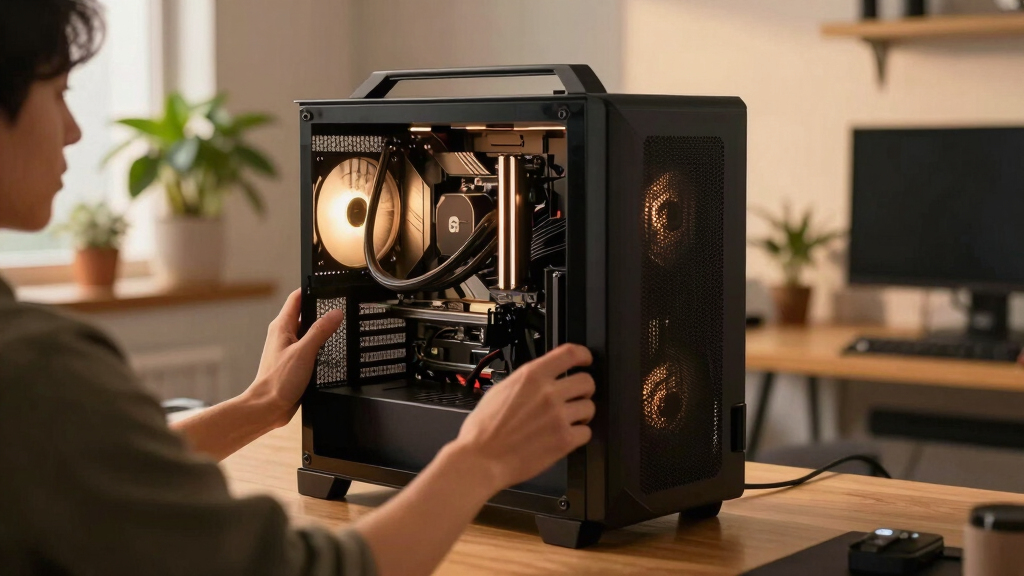

📊 Full opportunity report: Liquid vs Air Cooling for 24/7 Inference Rigs on ThorstenMeyerAI.com — validation score, market gap, and execution plan.

Get smart everyday buys delivered free with Prime
- Fast, free delivery on millions of items
- Prime Video, Amazon Music and more included
- Member-only deals all year
TL;DR
For 24/7 AI inference rigs, air cooling generally offers greater reliability, lower cost, and quieter operation than liquid cooling. Liquid cooling may be necessary only for high thermal headroom or space constraints.
For continuous operation of AI inference rigs, air cooling is generally the preferred choice over liquid cooling due to its simplicity, reliability, and lower total cost of ownership, according to industry experts.
Most 24/7 inference systems benefit from air cooling because it has fewer failure points and requires less maintenance. High-quality air coolers, like dual-tower models, can handle sustained loads comparable to mid-size liquid coolers at a lower cost and with quieter operation. Liquid cooling, especially all-in-one (AIO) units, offers higher thermal headroom for the hottest CPUs, such as those exceeding 200W TDP, and is advantageous in cases with space constraints or where heat must be expelled outside the case. However, AIOs contain a pump and sealed loop components that have a limited lifespan—typically 5 to 7 years—and are more susceptible to leaks and degradation over time. While modern AIOs are reliable, their pump failure or coolant leaks can result in system downtime or damage. Experts emphasize that for unattended, long-term operation, the simplicity and durability of air cooling outweigh the potential thermal benefits of liquid solutions, unless specific thermal or spatial requirements justify the latter.Liquid vs air
for a 24/7 inference rig.
For an always-on machine the question isn’t “which cools better” — it’s which one still works in three years without you thinking about it. That reframing makes air the default for most rigs. Answer three questions in Part 2 to find yours.
- Nothing to fail — fan swaps in minutes
- Lasts a decade+; lower total cost
- Quieter floor — no pump hum (~40–45 dBA)
- Trivial maintenance — wipe & repaste
- Tall — can block RAM, dumps heat in case
- Best headroom — ~360W TDP sustained
- Compact block — fits tight cases, clears RAM
- Exports heat out the radiator & room
- Pump fails at 5–7 yrs; replace whole unit
- Costs 2–3× more over its life; pump hum
- You run it 24/7 and want set-and-forget.
- Your CPU is mainstream-to-high-end (or power-capped).
- A big tower fits your case.
- You value lower cost and a quieter floor.
- Your CPU is too hot for air under sustained all-core load.
- A big tower won’t fit (compact / multi-GPU case).
- You need to export heat out of a warm room.
- RAM clearance is tight.
Why Reliability and Cost Matter for Continuous AI Operations
Choosing the right cooling method impacts the long-term stability, maintenance costs, and operational noise of AI inference rigs. Air cooling's durability and lower maintenance make it the preferred option for systems intended to run continuously without intervention, reducing total cost of ownership and minimizing downtime. Liquid cooling can provide higher thermal headroom but introduces complexity and potential failure points, which are critical considerations for unattended setups. Understanding these factors helps organizations optimize their infrastructure for reliability and cost-effectiveness.high quality air CPU cooler for 24/7 operation
As an affiliate, we earn on qualifying purchases.
As an affiliate, we earn on qualifying purchases.
Cooling Choices in AI Workstations and Inference Systems
Traditionally, gaming PCs and high-performance workstations have debated between air and liquid cooling, focusing on peak temperatures and benchmark performance. However, AI inference systems differ because they often operate continuously for extended periods, making reliability and maintenance priorities. Industry sources, including Thorsten Meyer, emphasize that for 24/7 workloads, air cooling's simplicity and longevity often outweigh the thermal advantages of liquid solutions. High-end air coolers can match the performance of mid-range AIOs in sustained loads, while liquid cooling is typically reserved for cases with space constraints or very high thermal demands. The choice impacts not only initial setup but also long-term operational costs and system uptime."For most 24/7 inference rigs, air cooling is the default — it's cheaper, simpler, quieter at the noise floor, and above all has nothing to fail."
— Thorsten Meyer
liquid cooling AIO for high TDP CPUs
As an affiliate, we earn on qualifying purchases.
As an affiliate, we earn on qualifying purchases.
Remaining Questions on Long-Term Reliability and Performance
While current data supports air cooling's reliability for 24/7 use, long-term performance beyond 7 years and the impact of coolant degradation in AIOs remain less documented. Leak risks, pump failures, and maintenance requirements are still areas where further empirical data would be beneficial to confirm the long-term superiority of one method over the other in specific setups.reliable 120mm or 240mm PC fan for continuous use
As an affiliate, we earn on qualifying purchases.
As an affiliate, we earn on qualifying purchases.
Monitoring Long-Term Performance and Evolving Cooling Technologies
As AI workloads grow and hardware evolves, ongoing monitoring of cooling performance and reliability will inform best practices. Manufacturers may develop more durable liquid cooling solutions or hybrid approaches, but currently, the consensus favors air cooling for unattended, sustained inference systems. Future research and real-world long-term data will clarify whether advancements can tilt the balance further toward liquid cooling.As an affiliate, we earn on qualifying purchases.
Key Questions
Is liquid cooling necessary for all 24/7 inference rigs?
No, most inference rigs can be effectively cooled with high-quality air coolers, which are simpler, more reliable, and cheaper over the long term.
How long do AIO liquid coolers typically last?
Most AIOs are designed to last about 5 to 7 years, with the pump being the primary failure point. Coolant degradation can also reduce effectiveness over time.
Are air coolers quieter than liquid cooling solutions?
High-quality air coolers often operate more quietly under sustained load than AIOs, which include a pump that adds a constant hum.
What are the main risks associated with liquid cooling?
The primary risks include pump failure, coolant leaks, and seal degradation, which can lead to system downtime or damage to other components.
When should I consider a liquid cooling solution for my inference rig?
If your CPU exceeds 200W TDP regularly, or if your case cannot accommodate large air coolers, or if heat needs to be expelled outside the case, a 360mm or larger AIO may be justified.
Source: ThorstenMeyerAI.com
Halloween Picks
halloween
As an affiliate, we earn on qualifying purchases.