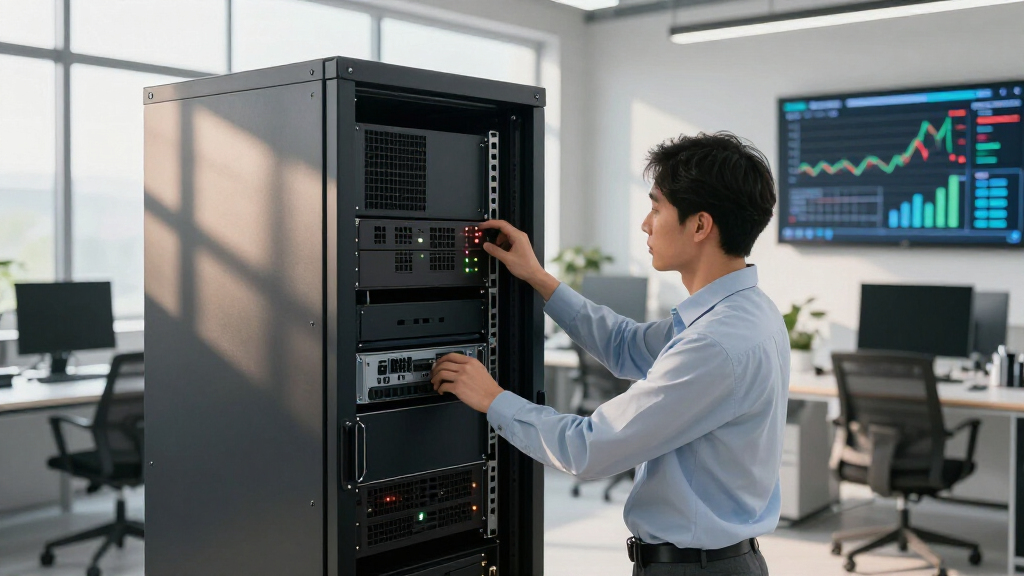

📊 Full opportunity report: How Agents Per Gigawatt Could Redefine AI Development Standards on ThorstenMeyerAI.com — validation score, market gap, and execution plan.
TL;DR
Thorsten Meyer introduces the concept of ‘agents per gigawatt’ as a new standard for measuring AI development. This shift emphasizes energy efficiency and autonomous cognition capacity over conventional metrics like model size or chip count. The development could reshape industry priorities and national strategies.
Thorsten Meyer argues that the emerging measure of AI capacity is now agents per gigawatt, shifting the focus from traditional metrics like model size or hardware count to energy efficiency and autonomous cognitive throughput. This new standard reflects how nations and companies will compete in the AI era, emphasizing their ability to convert energy into intelligence.
In his recent analysis, Thorsten Meyer states that the binding constraint on AI development is now power supply. The capacity to run more autonomous agents—models performing tasks such as drafting, analyzing, or negotiating—depends on the amount of electricity available to power data centers and chips. Unlike previous measures centered on human labor or hardware quantity, this new metric captures the energy-to-cognition conversion rate.
Meyer explains that each agent is essentially a stream of tokens processed by models, which require compute power. To increase agent capacity, more gigawatts of energy must be produced and efficiently converted into computation. This makes power generation and delivery the core bottleneck, intertwining the energy and AI buildout stories.
The industry is, whether explicitly acknowledged or not, engaged in a race to maximize agents per gigawatt. Hardware innovations—such as specialized inference chips, low-voltage designs, and optical interconnects—aim to improve this ratio, boosting the number of agents that can operate per unit of energy.
Every era measures power in whatever is scarce: land, then steel, then GDP. The binding constraint is changing again — and the new unit is how much autonomous cognition a nation or company can produce per unit of energy it can command.
▲ Opinion & analysis · not investment adviceMore agents means more tokens, which takes compute, which takes chips, which take one thing above all — power. The energy story and the AI story became the same story.
Once you hold it, the separate stories of the moment stop being separate — they’re all the same ratio, seen from different angles.
Adopting it drags three things into the open that softer framings let you avoid.
And the unit rewards concentration — unless we deliberately build against it.
Implications of the Agents-per-Gigawatt Metric for Global AI Power
This shift in measurement fundamentally redefines how national and corporate AI capabilities are assessed. Countries with abundant energy resources and advanced infrastructure will have a competitive advantage, as their sovereign agents-per-gigawatt capacity determines how much autonomous cognition they can sustain independently.
It also reframes industry priorities: hardware innovation, energy procurement, and power efficiency become central to AI progress. Investment strategies and policy decisions will likely pivot toward expanding energy capacity and optimizing energy-to-cognition conversion, rather than solely focusing on model complexity or data scale.
Ultimately, this new metric could influence how AI development is funded, regulated, and geopolitically contested, making energy infrastructure a critical national asset in the AI era.

Ascend AI Processor Architecture and Programming: Principles and Applications of CANN
As an affiliate, we earn on qualifying purchases.
As an affiliate, we earn on qualifying purchases.
How the Energy-Centric View Changes AI Industry Dynamics
Historically, AI progress has been measured by model size, number of parameters, or hardware capabilities. Over the past two years, a shift has occurred as autonomous agents—software models capable of independent thought—have become central to AI deployment. This transition aligns with the recognition that the power consumption of data centers and chips now limits the scale of AI operations.
Thorsten Meyer’s concept of agents per gigawatt builds upon this understanding, emphasizing the importance of energy efficiency in AI hardware design. The competition for power purchase agreements and the construction of new nuclear plants and datacenters are direct manifestations of this energy-driven race, transforming the narrative from hardware arms races to energy infrastructure battles.
This perspective is a departure from traditional industry metrics, framing AI growth as a function of energy capacity rather than just technological innovation.
"The real limit on autonomous cognition is how much power we can generate and convert into intelligence. Agents per gigawatt captures this reality precisely."
— Thorsten Meyer

5 PCS Low Voltage Mounting Bracket, Black, Low Voltage Box
- High-Quality PC Material: Durable and flexible construction
- Adjusts to Wall Thickness: Fits 0.16 to 0.78 inch walls
- Compatible with Various Cables: Supports phone, network, HDMI, coaxial
As an affiliate, we earn on qualifying purchases.
As an affiliate, we earn on qualifying purchases.
Unresolved Questions About Global Adoption and Measurement
It is still unclear how quickly the industry will adopt agents per gigawatt as a standard metric. While Meyer’s framework offers a compelling lens, there is no consensus on how to precisely measure or compare this ratio across different countries or companies. Additionally, the impact on existing industry metrics and funding models remains to be seen, and policymakers have yet to formalize this approach into strategic planning.
Optical Interconnects for Data Centers (Woodhead Publishing Series in Electronic and Optical Materials)
As an affiliate, we earn on qualifying purchases.
As an affiliate, we earn on qualifying purchases.
Next Steps for Industry and Policy in Energy-Driven AI Metrics
Industry leaders are likely to accelerate hardware innovations aimed at boosting agents per gigawatt. Governments and investors may begin prioritizing energy infrastructure projects that support AI growth, such as nuclear and renewable power plants. Meanwhile, standard-setting organizations could start developing frameworks for measuring and benchmarking energy-to-cognition conversion rates.
Further research and industry consensus are needed to formalize this metric and integrate it into strategic planning and international competition assessments.

ASRock Intel Arc Pro B60 Creator 24GB Graphics Card, Workstation GPU, Xe2-HPG, 2400MHz, 24GB GDDR6 192-bit, PCIe 5.0, 4X DP 2.1, Blower
- System Compatibility: 2-slot, 271x112x39mm, 200W TDP
- Customer Support: Contact us via Amazon for assistance
- Memory & Bandwidth: 24GB GDDR6, 456 GB/s bandwidth
As an affiliate, we earn on qualifying purchases.
As an affiliate, we earn on qualifying purchases.
Key Questions
Why is 'agents per gigawatt' considered a better measure than traditional metrics?
Because it directly captures the core constraint on autonomous AI capacity—energy availability—rather than hardware or model size, which are secondary factors in energy-limited environments.
How does this new metric affect national AI strategies?
It emphasizes the importance of energy infrastructure and efficiency, potentially shifting focus toward energy independence, power generation capacity, and hardware optimization to increase sovereign AI capabilities.
Will this change industry investment priorities?
Yes, investments are expected to increasingly target energy supply and hardware innovations that improve agents-per-gigawatt ratios, making energy efficiency a central goal.
Is this concept already being used in industry or government?
While the concept is gaining traction among thought leaders like Thorsten Meyer, it has not yet been formalized as an industry standard or policy metric.
Source: ThorstenMeyerAI.com