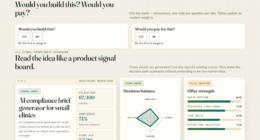

📊 Full opportunity report: Capital: The Lever Beneath the Levers on ThorstenMeyerAI.com — validation score, market gap, and execution plan.
TL;DR
In 2026, the largest private AI companies are transitioning their risk into public markets through massive IPOs, revealing how capital controls AI infrastructure buildout. This cycle’s circular funding creates systemic vulnerabilities, with implications for the broader economy.
In 2026, the largest private AI firms, including SpaceX’s xAI, Anthropic, and OpenAI, have announced plans for major public listings, marking a significant shift in how AI development is financed and revealing the central role of capital as a chokepoint in the industry.
On June 12, SpaceX, now containing xAI, listed on the Nasdaq at a valuation near $1.77 trillion, briefly surpassing $2 trillion in early trading. The offering was heavily oversubscribed, with a significant portion of shares allocated to retail investors. Simultaneously, Anthropic and OpenAI are preparing for IPOs valued at roughly $965 billion and $730–$850 billion, respectively, with a combined private valuation exceeding $4 trillion.
These public offerings transfer risk from early private investors to the broader market, with over $6.6 billion in OpenAI stock already sold on secondary markets prior to listing. The flow of capital is circular: Microsoft, Amazon, and Google invest heavily in Nvidia, which supplies AI chips, while these tech giants fund AI startups through cloud credits, creating a self-reinforcing loop.
This circular funding pattern fosters demand-driven growth but also introduces vulnerabilities. Recent signs include Microsoft’s reduced commitment to AI compute supply, hinting at caution amid a fragile cycle. The entire infrastructure buildout relies heavily on debt-financed capital expenditure, with estimates of $3 trillion in global data-center spending between 2025 and 2028, much of it private credit, against a small paying customer base.
Capital: The Lever Beneath the Levers
Every chokepoint costs money — so whoever can fund the buildout decides who builds at all. In 2026 the bill came due in public: a trillion-dollar IPO wave, financed by a circle of firms paying each other, now sold to everyone else.
The meta-chokepoint: it gates the other five, because you can’t build any of them without clearing the capital bar. A synchronized machine has no natural brake — no one can slow first — and the IPO wave moves the risk to the public as insiders take gains. The hedge is solvency that doesn’t depend on the music playing: sane burn, own what’s cheap, self-host where you can.
Why Capital Control Matters in AI’s Growth and Risks
This concentration of funding power in a few mega-corporations and the circular flow of capital create systemic risks. The reliance on debt and speculative valuations makes the industry vulnerable to shocks, which could spill over into the broader economy. The shift of risk from private to public markets at high valuations raises concerns about potential market corrections and economic fragility, especially if demand weakens or if key players pull back.

AI Chip Design: From Transistors to Neural Networks
As an affiliate, we earn on qualifying purchases.
As an affiliate, we earn on qualifying purchases.
The Financial Ecosystem Fueling AI Expansion
Historically, AI development has been driven by private investment and strategic corporate funding. In 2026, this model has accelerated, with private valuations reaching trillions and IPOs serving as a mechanism to reprice and redistribute risk. Major tech firms like Microsoft and Google have embedded AI investments into their core business models, fueling a circular flow of capital through cloud services, chip supply, and startups. This pattern has intensified as AI infrastructure costs balloon, with estimates of $700 billion in hyperscale data-center spending planned for 2026 alone.
However, the demand for AI services remains limited among consumers, with only about 3% paying for AI products. Economists warn that this imbalance—massive debt-financed infrastructure against modest direct revenue—could threaten economic stability, especially if demand falters or if the cycle breaks down.
“The current liquidity and greed-driven environment mask underlying fragilities that could destabilize markets if confidence wanes.”
— Goldman Sachs executive

Ricky The Rack™ – Emotional Support Server Rack Plush | Funny IT Gift for Sysadmins, Devops Engineers & Data Center Teams
🖥️ When Servers Go Down, Ricky Stays Up – The only rack in your data center that never…
As an affiliate, we earn on qualifying purchases.
As an affiliate, we earn on qualifying purchases.
Unconfirmed Risks and Potential Market Shocks
It remains unclear whether the current high valuations and debt levels will sustain or trigger a correction. The precise impact of a potential slowdown in demand or a shift in investor sentiment on the entire AI funding cycle is still uncertain, as is the extent to which systemic vulnerabilities could materialize into broader economic shocks.

Cloud Computing: Concepts, Technology, Security, and Architecture (The Pearson Digital Enterprise Series from Thomas Erl)
As an affiliate, we earn on qualifying purchases.
As an affiliate, we earn on qualifying purchases.
Next Steps for Monitoring AI Funding and Market Stability
Regulators, investors, and industry leaders will closely watch upcoming IPOs, corporate investment patterns, and macroeconomic indicators. Any signs of reduced demand, retreat by key players like Microsoft, or market corrections could signal a reevaluation of the current funding model. Further transparency on AI infrastructure costs and demand will be critical to assess ongoing risks.

AI Secret Funding Vault: The EIN-Only Playbook for No-Personal Guarantee Business Capital (Bosses Build Business Credit)
As an affiliate, we earn on qualifying purchases.
As an affiliate, we earn on qualifying purchases.
Key Questions
Why are AI companies going public now?
They are seeking to reprice and transfer private investment risk into public markets amid high valuations and large fundraising rounds, enabling early investors to realize gains while funding further growth.
What is the main risk of this capital cycle?
The cycle’s reliance on debt-financed infrastructure and circular demand makes it vulnerable to shocks, which could trigger market corrections and threaten broader economic stability.
How does this funding model affect the broader economy?
It increases systemic fragility because massive infrastructure spending is driven by speculative valuations and private credit, with limited direct consumer demand, raising risks of economic shocks if the cycle breaks.
Who controls the capital chokepoint in AI development?
Major tech giants like Microsoft, Amazon, and Google, along with large private investors, are the key players holding the capital chokepoint, shaping the industry’s future through their funding decisions.
Source: ThorstenMeyerAI.com