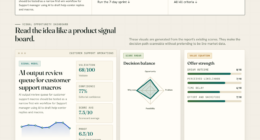

📊 Full opportunity report: The Switch: You Never Owned the AI You Depend On on ThorstenMeyerAI.com — validation score, market gap, and execution plan.
TL;DR
In 2026, both government actions and company decisions have demonstrated that AI models are not owned but accessed through APIs that can be cut off at any time. This highlights a critical vulnerability in reliance on third-party AI services.
On June 12, 2026, the U.S. government issued an export-control directive that forced Anthropic to disable its latest models, Fable 5 and Mythos 5, globally within roughly ninety minutes, citing national security concerns. Simultaneously, OpenAI announced the retirement of GPT-4o and other models, removing them from ChatGPT with minimal warning. These events confirm that AI models are accessed via APIs that can be revoked instantly, rather than owned outright, exposing a critical vulnerability in reliance on third-party AI services.
The June directive from U.S. authorities abruptly cut off access to Anthropic’s models worldwide, including for its own employees, demonstrating that government can switch off AI models at will through export controls. This move was made without detailed explanation, leaving the company no choice but to disable the models immediately. Meanwhile, OpenAI’s decision to deprecate GPT-4o and similar models in February was driven by economic considerations, not security, but resulted in API shutdowns and the removal of these models from services, with users facing errors and migration deadlines. Both incidents underscore a fundamental shift: AI models are not owned by users but are accessible through control points that can be turned off or altered at any moment, whether by governments or companies.
The Switch: You Never Owned It
In 2026 a government turned off a frontier model worldwide in ~90 minutes — and a company retired a beloved one with ~2 weeks’ notice. You don’t own the model you build on. You access it. Access can be revoked.
Access is the only chokepoint that flips in an afternoon — and the version that hits you won’t be Washington, it’ll be a deprecation. Open weights you host can’t be deprecated, geofenced, repriced, or revoked. Short of that: route through a provider-agnostic gateway, keep a tested fallback, and treat every model string as a dependency that will be pulled.
Implications of Instant AI Access Revocation
This development reveals that dependency on third-party AI models entails significant risk, as access can be revoked instantly, making reliance akin to a lease rather than ownership. For businesses and governments, this means that AI capabilities are not guaranteed and can disappear suddenly, impacting security, operations, and strategic planning. It also raises questions about the long-term viability of AI reliance without ownership rights, emphasizing the need for alternative approaches such as in-house models or more resilient infrastructure.
AI model ownership backup tools
As an affiliate, we earn on qualifying purchases.
As an affiliate, we earn on qualifying purchases.
Evolution of AI Control and Dependency
Historically, AI development required extensive resources, but the rise of API-based models democratized access, enabling widespread adoption without ownership. The recent incidents mark a shift from this model, illustrating that access points—such as APIs—are now the new chokepoints. Governments have historically controlled physical goods and data, but in 2026, they demonstrated the ability to remotely switch off AI models via export controls. Similarly, companies regularly deprecate older models for economic reasons, further consolidating control over AI access. These developments underscore a landscape where AI dependency is fragile and subject to sudden change, with control concentrated in a few hands.
“Applying export controls to deployed AI models effectively acts as an emergency off-switch, revealing how easily access can be revoked.”
— former U.S. administration AI adviser

Local LLM Inference Optimization: A Comprehensive Guide to Quantization, Hardware Acceleration, and Efficient Private AI Deployment
As an affiliate, we earn on qualifying purchases.
As an affiliate, we earn on qualifying purchases.
Unclear Long-Term Impact of Instant Shutdowns
It remains uncertain how widespread and enduring these control measures will become, or whether new safeguards will emerge to mitigate sudden shutdown risks. The long-term implications for AI innovation, security, and economic stability are still developing, and the balance of power between governments, corporations, and users continues to shift.
AI model offline access device
As an affiliate, we earn on qualifying purchases.
As an affiliate, we earn on qualifying purchases.
Future Responses to AI Access Vulnerabilities
Expect increased efforts toward in-house AI development, more resilient infrastructure, and regulatory debates on ownership rights versus access control. Governments may refine export controls, while companies could implement backup systems or alternative deployment strategies to reduce dependency on external APIs. Ongoing discussions will shape the future landscape of AI ownership and control.
AI model migration software
As an affiliate, we earn on qualifying purchases.
As an affiliate, we earn on qualifying purchases.
Key Questions
Can I still own an AI model outright?
Currently, most AI models are accessed via APIs controlled by third parties, meaning users do not own the models but rely on access that can be revoked at any time.
What triggered the U.S. government to shut down Anthropic’s models?
The U.S. issued an export-control directive citing national security, which mandated immediate disabling of Anthropic’s models worldwide without detailed explanation.
Are companies also able to shut down models at will?
Yes, companies regularly deprecate or reprice models, and can restrict access regionally or limit usage, effectively controlling availability without owning the models.
Does this mean AI is no longer reliable?
It highlights that reliance on external AI models carries risks, as access can be revoked suddenly, impacting reliability and operational continuity.
What can users do to protect themselves from sudden shutdowns?
Developing in-house models, maintaining local copies, or diversifying AI providers are potential strategies to mitigate dependency risks.
Source: ThorstenMeyerAI.com