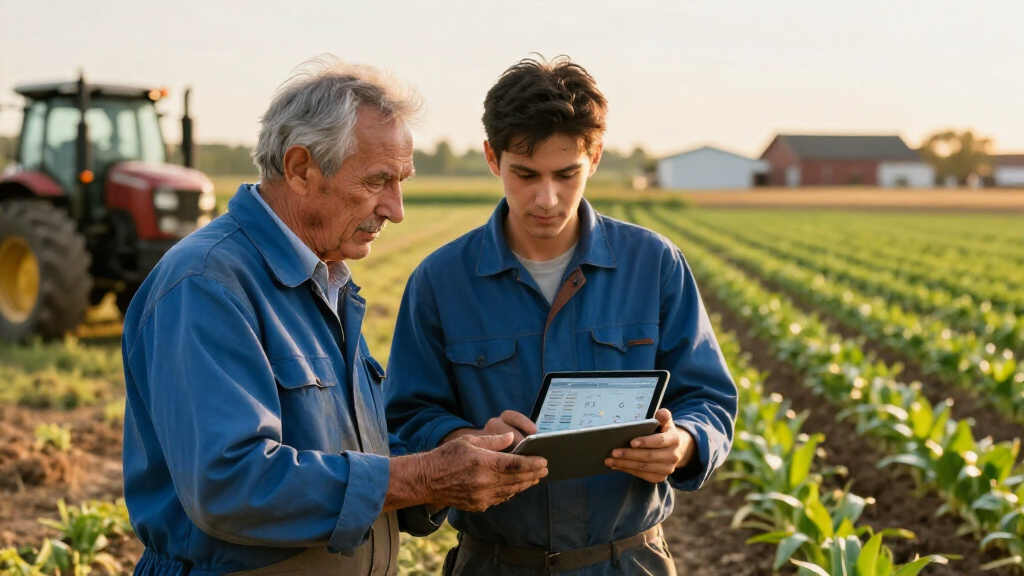

🔍 Read the full analysis: From Agriculture To Artificial Intelligence: A Story Of Work on ThorstenMeyerAI.com

Get smart everyday buys delivered free with Prime
- Fast, free delivery on millions of items
- Prime Video, Amazon Music and more included
- Member-only deals all year
TL;DR
A November 3 article on ThorstenMeyerAI.com uses agriculture’s long shift toward mechanisation and higher output to examine how work may change as artificial intelligence develops. It reports that about 928 million people still work in agriculture worldwide and presents the idea that AI could eventually automate much of a sector as the author’s thesis, not a confirmed forecast.
Thorsten Meyer published an article on November 3 examining how agricultural employment declined as tools, fertiliser and crop breeding raised output, and using that history to discuss possible AI-driven changes to work. The article’s central comparison is historical; its suggestion that automation could eventually encompass up to 90% of a sector is Meyer’s thesis, not an established forecast.
Meyer’s account, published on ThorstenMeyerAI.com as Work After Work, Episode 2, says that about 73.7% of the US labour force worked in agriculture in 1800, based on an estimate by economic historian Stanley Lebergott later published by the US Census Bureau. The underlying figure counts 1.4 million agricultural workers in a labour force of 1.9 million people aged 10 and older. Meyer stresses that early figures are estimates, not census counts, and that the 1800 labour force included about 530,000 enslaved people.
The article describes agricultural change as a sequence rather than a single invention. It cites John Deere’s account of a steel plough made in 1837, the industrial production of ammonia after Fritz Haber’s 1908 patent, and the spread of short-straw wheat during the Green Revolution in the 1960s. According to India’s official statistics cited by Meyer, wheat output rose from 12.3 million tonnes in 1964–65 to 26.4 million tonnes in 1971–72. The article says the earlier year is used as the comparison baseline rather than the drought-affected 1965–66 harvest.
Meyer reports that agricultural employment continued to grow in absolute numbers even as its share of the US workforce fell, reaching about 11.8 million workers around 1910. For a more recent global measure, he cites an International Labour Organization estimate of 928 million people working in agriculture in 2025, roughly one in four workers worldwide. The article gives country figures of about 43% of workers in India, 1.5% in the US and 1% in Germany; these are presented as employment shares, not counts of farm output or productivity.
Farm History and AI Job Change
Agriculture offers a concrete historical case for a question now attached to artificial intelligence: whether technology removes jobs, changes them, or shifts workers into other parts of the economy. Meyer’s account shows that a sector can become a much smaller source of employment without food production disappearing. The implication is not that AI will follow the same path, but that employment shares and output can move in different directions.
The scale of farming’s change also cautions against treating automation as an immediate event. In the US, the employment shift played out over roughly two centuries, according to the historical figures in the article. That pace and trajectory may not apply to AI, whose adoption, affected occupations and effects on wages remain unsettled. Still, the comparison helps readers distinguish automation of tasks from the broader question of what happens to workers and the economy.
The global figures underline that this change is far from complete. With an estimated 928 million people still working in agriculture, the transition has proceeded unevenly across countries. That matters for any comparison with AI: the consequences of technological change depend on local employment, infrastructure and the alternatives available to workers.
Products Worth Considering

Dell UltraSharp 27 Thunderbolt Hub Monitor (U2726DER), QHD

FLEXISPOT 60-Inch Executive Standing Desk with Drawers and CPU Cabinet

Logitech MX Brio Ultra HD 4K Webcam, Graphite
As an affiliate, we earn on qualifying purchases.
How Farm Work Changed Over Time
Meyer’s article is the second episode in a series that divides economic activity into field, factory and office. The first episode introduced that framework; this installment focuses on agriculture as a long-running example of work transformed by technology. The article says the US is not the only case: historical estimates put agriculture or the broader primary sector at about 85% of Japan’s gainfully occupied population in 1872, while India’s 1951 census counted cultivators and agricultural labourers as 69.7% of workers. These estimates have different dates and definitions, so they should not be read as directly comparable measurements.
The article links rising farm productivity to several developments. Deere’s company history describes a steel plough designed to shed sticky Midwestern soil. Haber filed a patent in 1908 for synthesising ammonia, a process that helped make nitrogen fertiliser available at industrial scale. Later, dwarf wheat varieties bred in the 1960s could produce more grain without their stalks falling over, especially when paired with fertiliser and irrigation. Together, such changes reduced the amount of human labour needed for food production, while agricultural output increased.
Meyer cites two measures to counter the idea that fewer farmers must mean less food: global cereal production increased 4.2-fold from 1961 while population grew 2.7-fold, and US farm output in 2023 was nearly three times its 1948 level with only a small rise in total inputs. These are figures reported by the article; the supplied material does not provide the underlying datasets or definitions of “total inputs.”
“The share fell long before the headcount.”
— Thorsten Meyer, in the article
Limits of the AI Comparison
The article does not establish that AI will displace workers at the same scale or pace as agricultural technology. Its claim that automation could encompass up to 90% of a sector is explicitly Meyer’s thesis; the source material does not specify how that percentage is defined, which sector it refers to, or what evidence would confirm it.
Some historical numbers also carry qualifications. The 1800 US labour-force figures are estimates, and the country comparisons draw on different dates and categories, including “primary sector” in some cases rather than farming alone. The article’s supplied material gives headline productivity comparisons but does not include full underlying calculations. It also does not detail how agricultural workers moved into other occupations, or how effects differed by class, race and region beyond noting that the early US count included enslaved people.
It remains unclear how quickly AI will be adopted, which jobs or tasks will be affected, and whether new work will absorb people displaced from existing roles. The article makes a historical comparison, not a claim that these outcomes are already known.
Further Episodes and Evidence
Meyer identifies this installment as Episode 2 of the Work After Work series and says Episode 3 will cover mechanical reapers, threshers and tractors. That episode may extend the account of how farm machinery changed labour needs, but the supplied material does not give a publication date.
For the AI comparison, the next useful evidence will be measured changes in employment, tasks, wages and output as organisations adopt AI. Until those figures are available over time, agriculture can serve as a historical reference point, but not a reliable forecast of how many jobs AI will remove or create. Meyer’s article leaves that question open.
Key Questions
What is the news in this article?
Thorsten Meyer published a November 3, 2026 article comparing the long-term transformation of agricultural work with possible effects of artificial intelligence on employment.
How many people still work in agriculture worldwide?
The article cites an International Labour Organization estimate of 928 million workers in 2025, or about one in four workers globally.
Does the article predict that AI will automate 90% of jobs?
No. Meyer says automation could become a sector of up to 90% within a decade or a few decades, but labels this his thesis. The supplied source does not define the figure or establish it as a forecast.
Did fewer farm workers lead to less food production?
The article argues that the historical record does not support that conclusion. It cites increases in cereal production and US farm output alongside major changes in agricultural employment. Those figures describe past production, not a guarantee about future food supplies.
What is not yet known about AI and work?
The article does not establish which occupations AI will affect, how quickly adoption will happen, or whether new jobs will offset losses. It presents agricultural history as a comparison, not proof of a future outcome.
Source: ThorstenMeyerAI.com