
📊 Full opportunity report: Wellness Check-Ins By Voice For Older Adults Living Alone on IdeaNavigator AI — validation score, market gap, and execution plan.

Get smart everyday buys delivered free with Prime
- Fast, free delivery on millions of items
- Prime Video, Amazon Music and more included
- Member-only deals all year
TL;DR
IdeaNavigator AI describes a proposed service that would use daily AI phone calls to check on older adults living alone and notify a family member when a call is missed or raises concern. The proposal recommends testing it with 15 senior-and-family pairs for three weeks; it reports no completed pilot, measured outcomes or launched product.
IdeaNavigator AI has proposed testing a daily AI phone check-in service for older adults living alone, designed to notify a family member if a call is missed or a response raises concern. The proposal recommends a three-week trial with 15 senior-and-family pairs, but does not report that a pilot has begun or that a service is available.
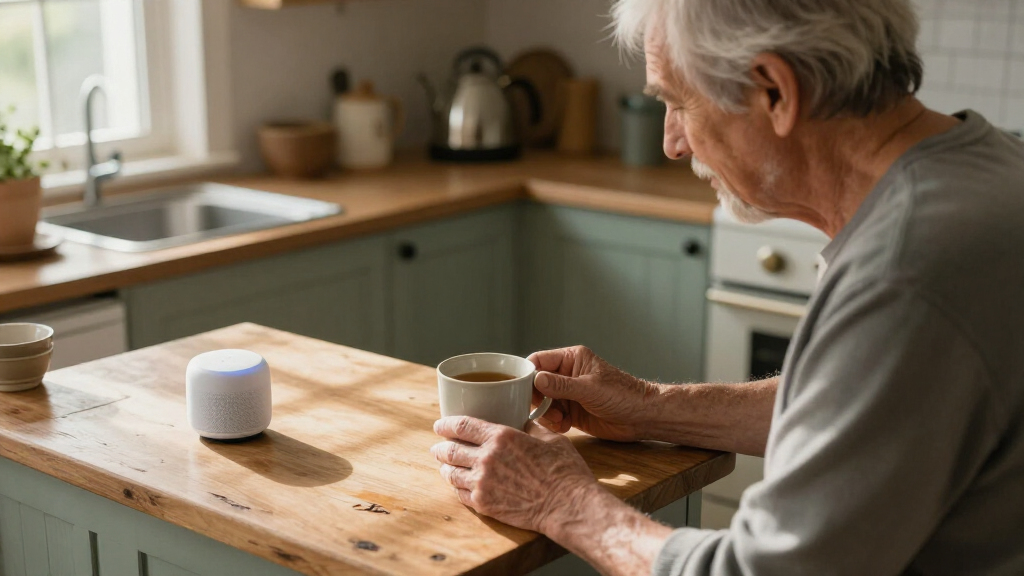
The concept is aimed at an adult child whose independent parent lives in another city. A system would place a scheduled call to the older adult’s landline or mobile phone, ask a few questions about their wellbeing, and send the family member a brief status message. The proposed notification would be an all-clear or a flag for a missed or concerning call.
IdeaNavigator AI presents natural-sounding voice technology as a reason such calls may now be practical and affordable at scale. That is the proposal’s rationale, not evidence of performance: it provides no pricing, technical specifications, clinical assessment or test results. The suggested business model is a monthly subscription paid by the adult child for each parent receiving calls.
For validation, the proposal calls for enrolling 15 senior-and-adult-child pairs and running calls for three weeks. It says the test should track whether seniors answer and whether families consider the all-clear alerts valuable enough to pay for. It does not specify how a concerning answer would be assessed, who would follow up, or what would happen if an older adult needed urgent help.
A Routine Check, Not Emergency Care
A scheduled call could give families a regular signal about whether an older relative has answered and responded to simple questions. For adult children who cannot phone every day, that may offer more routine contact and help identify a missed check-in sooner than an informal calling pattern would. Whether it provides meaningful reassurance depends on the system’s reliability and on what happens after an alert.
The distinction between a wellness prompt and a safety service matters. An unanswered call does not establish that someone has fallen or is unwell; a completed call does not prove that there is no problem. The proposal describes notifications to family, not emergency response, medical monitoring or a guaranteed intervention. Families would need clear expectations about alert timing, follow-up responsibilities and the limits of automated calls.
The proposed trial’s answer rate and willingness-to-pay measures would give an initial indication of whether the workflow is usable and valued by the families involved. They would not, by themselves, show that the service prevents harm or works reliably across a broader population. Those questions would require further evidence beyond a small, short pilot.
Products Worth Considering

Samsung 27-inch Odyssey OLED G6 QD-OLED QHD Gaming Monitor

LG 34GX90SA-W 34-inch Ultragear WQHD OLED Curved Gaming Monitor

LG UltraGear 27-Inch QHD OLED Gaming Monitor, 240Hz, 0.03ms, G-SYNC Compatible, FreeSync Premium Pro, HDMI 2.1
As an affiliate, we earn on qualifying purchases.
How the Proposed Pilot Works
The idea is framed as a narrow first use for voice AI: a short, scheduled phone call rather than a broader system for elder care. The proposed call would ask a small number of wellness questions. Afterward, a family member would receive a simple status update, with a flag if the call was missed or a response was concerning.
The target problem is that relatives may worry about a parent living alone but cannot make contact every day. In the proposed scenario, an incident or a difficult day might go unnoticed until someone checks in. The concept seeks to create a repeatable contact point, while placing the subscription cost on the adult child rather than the older person.
The plan’s next step is validation rather than a stated commercial launch: test the service with 15 pairs for three weeks and assess call answer rates and perceived value. No deployment, participant recruitment, funding, operating company or release schedule is identified in the proposal.
Pilot Results and Safety Protocols
No pilot findings are reported. It remains unclear whether the proposed calls have been built, when or where a trial might take place, or whether older adults and their families would consent to participate. The proposal also gives no evidence for its claim that current voice AI can make these calls affordable at scale.
Operational details are not set out. There is no information on how the system would distinguish a concerning response from an ordinary one, how it would handle poor connections or repeated non-answers, or how quickly a family member would receive a message. The plan does not describe escalation procedures, emergency-service contact, privacy and data retention practices, or whether a person would review flagged calls.
It is also unknown how the service would work for people with hearing, speech, memory or language needs, and whether calls would be accessible across different phone types. The proposed measures—answer rate and family willingness to pay—would not establish that the system correctly identifies health or safety problems. Those limits should be considered before treating an alert or all-clear as a dependable assessment of someone’s condition.
Testing Before Any Wider Rollout
The next step described by IdeaNavigator AI is a three-week test involving 15 senior-and-family pairs. The proposed measures are how often older adults answer the calls and whether family members see enough value in the alerts to pay for them. No date, location, recruitment plan or organizer for that trial has been announced in the material provided.
If a pilot is conducted, its findings could clarify whether participants will use a daily automated call and whether the basic notification format is useful to families. Further development would also need to address reliability, privacy, accessibility and response procedures. Until results and operating details are available, the concept remains a proposal for validation, not a demonstrated service or substitute for personal contact and emergency support.
Source: IdeaNavigator AI
Key Questions
Has the AI check-in service launched?
No launch is reported. IdeaNavigator AI describes a service concept and a proposed test, not an available product.
How would the proposed calls work?
A system would call an older adult daily on a landline or mobile phone, ask a few wellness questions, and send a family member an all-clear or a flag for a missed or concerning call.
What pilot is proposed?
The proposal suggests testing daily calls with 15 senior-and-adult-child pairs for three weeks, measuring call answer rates and whether families value the alerts enough to pay.
Would the system provide emergency or medical care?
The proposal does not describe emergency response or medical monitoring. A missed call or all-clear would not, on the information provided, confirm whether someone is safe or unwell.
What is still unknown?
No trial date, service price, technical details, safety protocol, privacy policy or pilot results are provided. It is also unclear how alerts would be reviewed and followed up.
Source: IdeaNavigator AI