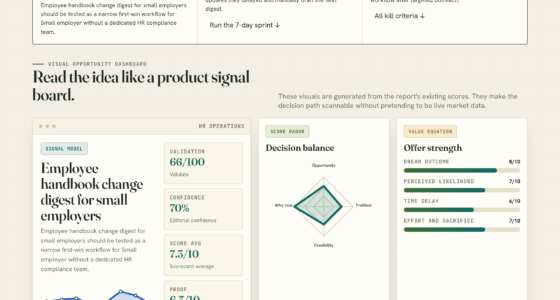
📊 Full opportunity report: 4 Steps To Review Your Benefits Before Resigning With AI on IdeaNavigator AI — validation score, market gap, and execution plan.

Get smart everyday buys delivered free with Prime
- Fast, free delivery on millions of items
- Prime Video, Amazon Music and more included
- Member-only deals all year
TL;DR

IdeaNavigator AI has proposed testing an AI assistant that reviews benefits documents and compares the potential financial effects of different resignation dates. The concept is an early-stage product proposal, not a reported launch or a proven service; its suggested validation is to examine 100 planned resignations and document any savings.
IdeaNavigator AI has outlined a proposed AI exit assistant that would help employees planning to resign compare how different departure dates could affect benefits, equity and pay. The concept would analyze uploaded employment documents and produce a date-comparison memo and checklist, but the proposal does not establish that a product has launched or that its calculations have been tested.
The proposed tool is aimed at one user group: employees planning a resignation. It would take in benefits documents and equity grant information, then compare candidate departure dates against items such as equity vesting, bonus eligibility, 401(k) matching, insurance coverage and PTO payout rules. Those terms vary by employer and plan, so the assistant’s usefulness would depend on accurately reading the documents and reflecting the relevant dates and conditions.
IdeaNavigator AI describes the intended output as an “optimal-date memo” and departure checklist. The proposal says the product could make money through a flat fee for each exit and would be positioned as employer-neutral. These are suggested product and business-model choices, not evidence that a service currently charges users or has established a customer base.
To test the idea, the proposal recommends running 100 planned resignations through the assistant and totaling documented savings against each participant’s originally intended departure date. No results from such a trial, information about participants, or method for independently verifying savings are included in the proposal.
How Departure Dates Affect Benefits
The idea addresses a practical timing problem: the date an employee leaves can affect compensation and coverage, sometimes under rules spread across separate plan documents, grant agreements and employer policies. A person who chooses a date without checking those terms may miss a vesting milestone, a bonus qualification date or a retirement-plan contribution, or may face a gap in health insurance. Whether any of those outcomes applies depends on the individual’s documents and circumstances.
A document-reading assistant could make it easier to compare those conditions before a resignation is final. That could be useful for employees who have several benefits to review and limited time to interpret them. But an automated summary would not itself change a plan’s terms, secure a payout or guarantee that a particular date is best. The proposed tool would need to show the evidence behind each calculation and distinguish clear document language from assumptions.
The proposal also makes a testable claim about potential value rather than reporting demonstrated results. Comparing recommended dates with users’ initial plans could reveal whether the assistant identifies missed opportunities, but documented savings would need a clear definition. A comparison should account for costs, eligibility conditions and whether a benefit would actually have been received, rather than treating every projected amount as money saved.
benefits analysis software for employees
As an affiliate, we earn on qualifying purchases.
As an affiliate, we earn on qualifying purchases.
A Proposed Narrow First Workflow
IdeaNavigator AI frames the assistant as a narrow first-use workflow, rather than a general-purpose career or financial planning product. The single target user is an employee considering resignation, and the central task is to compare departure dates against that person’s own benefits and equity paperwork. That framing keeps the proposed product focused on a specific decision point.
The proposal’s stated rationale is that job-switching remains elevated, benefits arrangements are becoming more complex, and document-reading language models can parse benefits materials quickly. Those points are presented as reasons to explore the product; the proposal supplies no labor-market statistics, independent evidence about changes in benefit complexity, or performance results for a particular AI system.
That distinction matters because reading a document is not the same as resolving every question about it. Some plan terms may depend on definitions, exceptions, employer practices or information not present in an uploaded packet. The concept therefore rests not just on extracting dates and amounts, but on reliably connecting the language to a person’s departure timeline and clearly communicating uncertainty.
employment benefits comparison tool
As an affiliate, we earn on qualifying purchases.
As an affiliate, we earn on qualifying purchases.
Product Testing And Accuracy Questions
It is unclear whether an assistant has been built, launched or used by employees. The proposal provides no product name, availability, pricing in practice, customer numbers or test findings. It also does not identify a developer or describe safeguards for handling sensitive employment, financial and insurance documents.
The suggested 100-resignation test is a proposed validation plan, not a completed study. No information is provided about how participants would be recruited, what counts as a documented saving, how calculations would be checked against plan administrators, or how the test would address dates that cannot be changed. The proposal also does not say how the system would handle incomplete documents, conflicting terms or errors in AI interpretation.
It is likewise unknown whether users would receive independent human review or be told to confirm important dates with their employer, plan provider or relevant professional. Until those details and test results are available, claims about accuracy, financial benefit and reliability remain unverified.
As an affiliate, we earn on qualifying purchases.
The Proposed 100-Exit Test
The next step set out in the proposal is to run 100 planned resignations through the assistant and compare the documented financial effect of its recommended dates with each user’s originally intended date. A meaningful report would need to explain the test method, the types of benefits reviewed, how savings were verified and whether any costs or trade-offs affected the recommendations.
No timetable for that test or later product release is provided. Until the trial is reported, the concept remains a proposed consumer employment tool rather than a validated way to choose a resignation date. Employees considering a departure would still need to check their own plan documents and confirm consequential terms with the relevant employer or provider.
Source: IdeaNavigator AI
As an affiliate, we earn on qualifying purchases.
Key Questions
Has the AI resignation assistant launched?
The available information describes a product proposal. It does not confirm a launch, public availability or an existing service.
What would the assistant review?
The proposed tool would analyze uploaded benefits documents and equity grants, comparing candidate resignation dates against terms such as vesting, bonuses, retirement matching, insurance transitions and PTO payout.
Has the assistant been shown to save employees money?
No results are provided. The suggested test of 100 planned resignations is a proposed validation plan, not evidence of completed trials or proven savings.
Can the tool determine the best resignation date for everyone?
The concept is intended to compare dates using each employee’s documents. No accuracy data is available, and benefit terms vary. Any recommendation would need to be checked against the applicable plan and employer rules.
Source: IdeaNavigator AI
Halloween Picks
halloween
As an affiliate, we earn on qualifying purchases.