

Choosing a calculator for personal finance depends less on the number of buttons than on the work you need it to do. I’d start with the HP 10bII+ for a more approachable algebraic input style and a broad mix of finance and statistics functions; the Texas Instruments BA II Plus is a stronger fit for buyers whose loan, cash-flow, or bond calculations need worksheet modes; and the CATIGA CF-300 puts core business and real-estate functions in a compact format. The HP 12C is the specialist pick for people who already prefer reverse Polish notation (RPN), not the easiest first calculator for everyone.

Get smart everyday buys delivered free with Prime
- Fast, free delivery on millions of items
- Prime Video, Amazon Music and more included
- Member-only deals all year
The main tradeoff is ease of entry versus specialized workflow. A familiar algebraic keypad can make everyday calculations feel more direct, while worksheet-based tools and RPN can speed up repeated or structured work once you know them. I ranked these calculators by how well their stated functions serve personal-finance tasks, how approachable their input and display are, and where their limitations could frustrate a buyer. None of these is a graphing calculator or a substitute for budgeting software: they are handheld tools for calculations such as payments, interest, cash flow, and amortization.
Key Takeaways
- Best starting point for mixed finance and statistics: The HP 10bII+ combines more than 100 functions with algebraic input, making it the most approachable all-rounder in this group.
- Best for worksheet-based finance: The TI BA II Plus offers cash-flow, amortization, bond-pricing, and statistics worksheets, but its modes take time to learn.
- Best compact business-focused option: The CATIGA CF-300 includes TVM, IRR, NPV, cash-flow, and break-even functions in a portable body with a hard case.
- Best for RPN users: The HP 12C has more than 120 functions and programmable capabilities, but buyers should be comfortable learning a different entry method.
- Check power and exam requirements before choosing: These options are battery-powered or have battery details listed, and exam approval varies; the HP 10bII+ and TI BA II Plus have different stated exam approvals.
| HP 10bII+ Financial Calculator, 100+ Functions, Statistics & Algebra |  | Best Overall for Mixed Personal-Finance Tasks | Calculator type: Financial | Functions: 100+; finance, statistics, and algebra | Input style: Algebraic | VIEW LATEST PRICE | See Our Full Breakdown |
| BA II Plus Financial Calculator | 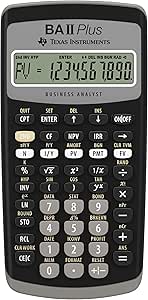 | Best for Finance Worksheets and Exam Candidates | Manufacturer: Texas Instruments | Calculator type: Financial | Functions: TVM, NPV, IRR, amortization, bonds, cash flow, and statistics | VIEW LATEST PRICE | See Our Full Breakdown |
| CATIGA Financial Calculator Business Analyst Master, TVM, IRR, NPV, Cash Flow, Amortization & Break-Even, 10-Digit LCD, CF-300 |  | Best Compact Pick for Business and Real-Estate Calculations | Model: CF-300 | Calculator type: Financial | Financial functions: TVM, IRR, NPV, cash flow, amortization, and break-even | VIEW LATEST PRICE | See Our Full Breakdown |
| HP 12C Financial Calculator – 120+ Functions, RPN, Programmable, Includes Case and Cloth |  | Best for Experienced RPN Users | Calculator type: Financial | Functions: 120+ | Entry method: RPN | VIEW LATEST PRICE | See Our Full Breakdown |
| calculators for personal finance | Calculator type | Functions | Financial functions | Power |
|---|---|---|---|---|
| HP 10bII+ Financial Calculator | Financial | 100+; finance, statistics, and algebra | TVM, interest rates, loan payments, NPV, and IRR | Battery-powered; one battery |
| BA II Plus Financial Calculato | Financial | TVM, NPV, IRR, amortization, bonds, cash flow, and statistics | — | One CR123A battery; included |
| CATIGA Financial Calculator Bu | Financial | — | TVM, IRR, NPV, cash flow, amortization, and break-even | Battery-powered; one battery |
| HP 12C Financial Calculator | Financial | 120+ | Loan amortization, bond pricing, NPV, and IRR | — |
More Details on Our Top Picks
HP 10bII+ Financial Calculator, 100+ Functions, Statistics & Algebra
I rank the HP 10bII+ first because it combines the functions most likely to matter in finance calculations with an input method many buyers will find more familiar than RPN. Its listed toolkit includes time value of money, interest rates, loan payments, NPV, and IRR, along with statistics and algebra functions. That makes it a practical fit for someone who wants one handheld calculator for payment comparisons, study, and occasional quantitative work rather than a device dedicated to one narrow routine.
Its algebraic input is the clearest distinction from the HP 12C. Users can enter calculations in a more conventional sequence instead of learning RPN, which lowers the initial learning burden for buyers coming from standard calculators. The HP 10bII+ also has stated approval for SAT, PSAT, and AP exams, while the BA II Plus is listed as approved for CFA, FRM, and CMA exams. Those approvals serve different needs, so I would match the model to the rules of the exact exam rather than treat either as universally permitted.
The tradeoff is that this is a capable non-graphing LCD calculator, not a visual planning tool. Its screen is listed as 4 inches, but it is not backlit, so dim rooms may make reading harder. It is battery-powered, and the provided details do not describe solar operation. Compared with the CATIGA CF-300, the HP offers more explicitly stated functions and exam information; compared with the BA II Plus, its pitch is broader and more approachable rather than centered on specialized worksheets. I’d pick it for a versatile finance calculator, but not for someone who needs graphing or a lit display.
Pros:- More than 100 listed functions cover finance, statistics, and algebra.
- Algebraic input is more familiar to many buyers than RPN.
- Includes TVM, loan payments, NPV, and IRR functions.
- Includes a protective case, cleaning cloth, and battery.
Cons:- The non-backlit LCD can be difficult to read in low light.
- Battery-powered operation means the calculator depends on a replaceable battery.
- No graphing capability is listed.
Best for: Buyers who want algebraic entry and a broad set of finance, statistics, and algebra functions for coursework and personal calculations.
Not ideal for: People who need a backlit display, graphing, or a calculator approved for a specific professional exam not listed for this model.
- Calculator type:Financial
- Functions:100+; finance, statistics, and algebra
- Input style:Algebraic
- Financial functions:TVM, interest rates, loan payments, NPV, and IRR
- Display:LCD; not backlit
- Power:Battery-powered; one battery
- Dimensions:6 x 3 inches
- Included items:Protective case, cleaning cloth, and batteries
Our verdict“I’d choose the HP 10bII+ as the most adaptable first financial calculator here, provided a non-backlit display is acceptable.”
BA II Plus Financial Calculator
The Texas Instruments BA II Plus is my pick for buyers who expect to work through structured finance problems rather than only enter a payment or interest calculation now and then. Its worksheet modes cover cash flow, amortization, bond pricing, and list-based statistics, alongside standard time-value-of-money functions. For personal finance, that structure can help when a buyer wants to examine a loan schedule or compare cash flows across periods without treating every problem as a fresh sequence of basic keystrokes.
Its clearest advantage over the HP 10bII+ is the emphasis on dedicated worksheet workflows and stated approval for CFA, FRM, and CMA exams. That makes it more directly aligned with finance candidates and users who recognize those worksheet conventions. The HP 10bII+ is the easier general recommendation for someone who values algebraic entry and a broader mix of stated subject areas; the BA II Plus makes more sense when its finance-specific modes and exam context matter more than a short learning curve.
There is a real cost in familiarity: buyers new to financial calculators may need time to understand the worksheet-based interface and recall where values are stored. Its supplied information also names a CR123A battery, a less common choice than batteries some buyers may already keep on hand. It includes a slide case and has a compact body, but the listing does not provide the same display-size detail available for the HP 10bII+. I would select it for repeated amortization and cash-flow work or relevant exams, and skip it if a conventional, immediately intuitive keypad matters more.
Pros:- Worksheet modes cover cash flow, amortization, bond pricing, and list-based statistics.
- Includes standard TVM functions and NPV and IRR capabilities.
- Stated approval for CFA, FRM, and CMA exams.
- Slide case protects the calculator during transport.
Cons:- Worksheet modes create a steeper learning curve for new users.
- Uses a CR123A battery, which may be less familiar or convenient to replace.
- Display size and backlighting are not specified in the supplied details.
Best for: Finance students and professionals who need worksheet modes for cash flow, amortization, bonds, or approved CFA, FRM, or CMA exam use.
Not ideal for: First-time users who want a conventional calculator flow, or buyers who prefer a more commonly available battery type.
- Manufacturer:Texas Instruments
- Calculator type:Financial
- Functions:TVM, NPV, IRR, amortization, bonds, cash flow, and statistics
- Worksheet modes:Cash flow, amortization, bond pricing, and list-based statistics
- Exam approvals stated:CFA, FRM, and CMA
- Power:One CR123A battery; included
- Dimensions:6.48 x 2.98 x 0.72 inches
- Protection:Slide case
Our verdict“I’d choose the BA II Plus over the HP 10bII+ when finance worksheets and its stated professional-exam approvals outweigh ease of learning.”
CATIGA Financial Calculator Business Analyst Master, TVM, IRR, NPV, Cash Flow, Amortization & Break-Even, 10-Digit LCD, CF-300
The CATIGA CF-300 earns its place for buyers who want a compact calculator aimed at business analysis and real-estate-style calculations. Its stated functions include TVM, IRR, NPV, cash flow, amortization, and break-even, a useful mix for working through loan choices, investment scenarios, and business decisions. At 6.46 inches long and 3.15 inches wide, it is easy to keep with documents or carry between home, class, and work; the hard case adds protection while it is stored.
Compared with the BA II Plus, the CF-300 presents a similarly relevant set of core financial functions but does not come with the same stated list of finance-exam approvals or worksheet detail. Compared with the HP 10bII+, its standout is the explicit business and real-estate framing, including break-even calculations. I’d consider it when compactness and those named tasks are the priority, rather than choosing it as the safest all-purpose recommendation for a student who needs a specific exam model or detailed documentation of workflow.
The biggest limitation is the small, 10-digit LCD, which may feel cramped when checking longer entries or reading numbers closely. It is battery-only, with no solar option listed, and the supplied description does not identify its entry method. That leaves more uncertainty for a buyer who wants to know exactly how keystrokes and worksheets compare with familiar algebraic calculators. I see this as a focused, portable business tool: appealing for its stated function set and hard case, but less compelling if screen comfort, explicit exam approval, or a clearly documented input style is central to the purchase.
Pros:- Includes TVM, IRR, NPV, cash-flow, amortization, and break-even functions.
- Compact body is easy to carry between work, home, and class.
- Hard case helps protect it during storage and transport.
- Function set is explicitly aimed at business and real-estate calculations.
Cons:- The 10-digit LCD and 2-inch screen may be small for detailed viewing.
- Battery-powered only; no solar option is listed.
- The supplied information does not state the input method or exam approvals.
Best for: Real-estate investors, business users, and finance learners who want a portable calculator with TVM, cash-flow, amortization, and break-even functions.
Not ideal for: People who need a larger display, confirmed exam approval, solar power, or detailed information about input style before buying.
- Model:CF-300
- Calculator type:Financial
- Financial functions:TVM, IRR, NPV, cash flow, amortization, and break-even
- Display:10-digit LCD
- Screen size:2 inches
- Power:Battery-powered; one battery
- Dimensions:6.46 x 3.15 inches
- Protection:Hard case
Our verdict“I’d pick the CF-300 for portable business and real-estate calculations, but choose the HP 10bII+ or BA II Plus when broader documentation matters more.”
HP 12C Financial Calculator – 120+ Functions, RPN, Programmable, Includes Case and Cloth
The HP 12C is the specialist choice in this group, built around reverse Polish notation rather than the algebraic entry listed for the HP 10bII+. It offers more than 120 functions, programming, and finance tools such as loan amortization, bond pricing, NPV, and IRR. For someone already comfortable with RPN, that combination can suit repeated professional calculations and established work habits. Its long-standing association with finance professionals is part of its appeal, but I would put workflow fit ahead of reputation when choosing a personal-finance calculator.
Compared with the HP 10bII+, the HP 12C asks more from the user at the keypad: RPN can be efficient once learned, but a buyer accustomed to ordinary algebraic entry may need deliberate practice. The BA II Plus takes a different specialist route through worksheet modes, while the HP 12C emphasizes RPN and programmability. That makes this model a better match for repeated calculations by an experienced user than a household buyer who mainly wants to compare a few loan payments or savings scenarios.
Its listed feature set is extensive, but the supplied details describe a desktop design and do not provide specific dimensions, screen size, or battery type. I would verify the current model details and physical fit if portability is important. It also has a learning curve and no solar option is listed. The included case and cleaning cloth help with storage, yet they do not change the central choice: this calculator is attractive when RPN is a deliberate preference, not when the buyer simply wants the most approachable device for basic personal-finance questions.
Pros:- More than 120 functions include amortization, bond pricing, NPV, and IRR.
- RPN entry can suit users who prefer that established workflow.
- Programmable functions support repeated calculations.
- Includes a case, cleaning cloth, and batteries.
Cons:- RPN has a learning curve for buyers used to algebraic entry.
- The supplied description labels it desktop-oriented and gives limited portability details.
- No solar power option is listed.
Best for: Finance, accounting, or real-estate users who already know RPN or plan to use programmable functions for repeated calculations.
Not ideal for: New users who want conventional algebraic entry, a clearly specified portable body, or a simple calculator for occasional household budgeting.
- Calculator type:Financial
- Functions:120+
- Entry method:RPN
- Programmable:Yes
- Financial functions:Loan amortization, bond pricing, NPV, and IRR
- Design:Desktop
- Included items:Case, cleaning cloth, and batteries
- Display details:Large display stated; exact size and backlighting not specified
Our verdict“I’d choose the HP 12C only when RPN and programmability fit the way I expect to work, rather than as the easiest first finance calculator.”

How We Picked
I compared these four calculators as tools for personal-finance calculations, not as general-purpose desktop calculators. I gave the most weight to whether a model covers recurring household and investing questions: loan payments, time value of money (TVM), amortization, net present value (NPV), internal rate of return (IRR), and cash-flow analysis. Those functions can help a buyer compare a borrowing scenario, estimate the effect of payment timing, or work through an investment calculation. I also looked at whether a calculator appears suited to routine use or assumes familiarity with finance coursework.
The ranking reflects practical fit, breadth, and learning demands. The HP 10bII+ leads because its listed algebraic input and broad range of finance, statistics, and algebra functions make it adaptable across tasks. The BA II Plus follows for its useful worksheet modes and stated finance-exam approvals, though those same modes may be less welcoming to a first-time user. CATIGA’s CF-300 earns a distinct role for compact business and real-estate calculations, but the available description provides less detail about input style and has a small stated screen. The HP 12C rounds out the list as a capable RPN and programmable specialist that is a better match for a buyer who values that workflow than for someone who wants conventional entry.
I treated display, portability, power, and protection as purchase factors rather than minor details. A calculator that is hard to read or inconvenient to carry can slow down repeated work, while a case can help protect it in a bag. I did not infer unlisted capabilities, such as solar power, a backlight, or specific exam approval. Product descriptions and supplied specifications are the basis for the comparisons here; buyers should confirm current exam rules and model details before relying on any calculator for a test.
| calculators for personal finance | Financial functions | Power | Included items | Protection |
|---|---|---|---|---|
| HP 10bII+ Financial Calculator | TVM, interest rates, loan payments, NPV, and IRR | Battery-powered; one battery | Protective case, cleaning cloth, and batteries | — |
| BA II Plus Financial Calculato | — | One CR123A battery; included | — | Slide case |
| CATIGA Financial Calculator Bu | TVM, IRR, NPV, cash flow, amortization, and break-even | Battery-powered; one battery | — | Hard case |
| HP 12C Financial Calculator | Loan amortization, bond pricing, NPV, and IRR | — | Case, cleaning cloth, and batteries | — |
Factors to Consider When Choosing Calculators For Personal Finance
I’d choose a financial calculator by starting with the calculations I expect to repeat, then checking which entry style and physical details will make those tasks manageable. A larger feature count alone does not tell me whether a calculator will be easy to use for comparing a mortgage, estimating an investment return, or studying for an exam.
Match functions to your real questions
For a personal loan, mortgage, or savings comparison, look for TVM and payment functions. These help relate interest, payment size, term, and present or future value. If I want to check an investment with uneven cash flows, NPV and IRR become more relevant. Amortization functions are useful when the balance and interest portions of payments matter, while break-even can help with a business decision. The HP 10bII+ and BA II Plus list broad finance tools; the CF-300 specifically names break-even; the HP 12C adds programmable capability for repeated work. I would not pay attention to function counts without asking whether those functions match the questions I actually need to solve.
Pick an input style you can learn and repeat
Algebraic entry, listed for the HP 10bII+, is closer to how many people use a standard calculator: enter an expression in its familiar sequence. The HP 12C uses RPN, which changes the order of entry and can suit experienced users, but may feel unfamiliar at first. The BA II Plus relies on worksheet modes for specific finance workflows, a different kind of learning demand. CATIGA’s supplied information does not identify its input style, so I would check the manual or product details if that point will affect comfort. When choosing between these approaches, I’d favor the one I can use accurately under time pressure over a longer list of functions.
Check exam rules independently
Exam approval is specific to the test and its current rules. The product information lists the HP 10bII+ for SAT, PSAT, and AP exams, and the BA II Plus for CFA, FRM, and CMA exams. Those are not interchangeable approvals, and the supplied descriptions do not establish approval for every finance qualification. I would confirm the exam provider’s current calculator policy, including restrictions on programmable functions or model variants, before buying. For someone using a calculator only at home, exam status may matter less than entry style, display readability, and the finance functions needed for loans and investments.
Treat screen and portability as everyday features
A calculator may have the right functions and still be awkward to use if its display is hard to read. The CF-300 lists a 10-digit LCD and 2-inch screen, which keeps the device compact but may be less comfortable for close checking than a larger display. The HP 10bII+ is described as non-backlit, a drawback in dim conditions. The BA II Plus and HP 12C listings provide less precise display information here, so I would verify it if screen visibility is a priority. Case type and dimensions also matter: the CF-300 has a hard case, the BA II Plus a slide case, and the HP 10bII+ includes a protective case. Consider whether the calculator will stay on a desk or travel in a bag.
Think about batteries and long-term convenience
Power details can affect how ready a calculator is for class, work, or a trip. The HP 10bII+ and CATIGA CF-300 are listed as battery-powered, while the BA II Plus specifies one included CR123A battery. The HP 12C description says batteries are included but does not identify a battery type in the supplied specifications. None of these listings establishes a solar option, so I would not assume one. Check the exact battery requirement and keep a replacement available if the calculator will be needed for an exam or a deadline. Battery convenience is a small detail until a device stops working at the wrong moment.
Separate everyday finance from specialist workflows
A household buyer who wants to compare payment scenarios may not need bond pricing, statistics, or programmable routines. The HP 10bII+ is the broadest approachable fit in this roundup, while the CF-300 focuses on a compact business-oriented collection of functions. The BA II Plus makes more sense for worksheet-driven finance study and relevant exams. The HP 12C is best treated as a deliberate RPN choice. I’d match the calculator to how often I will use its specialist features; otherwise, extra complexity can make everyday calculations slower rather than easier.
Frequently Asked Questions
Which calculator is the easiest starting point for personal finance?
I’d start with the HP 10bII+ if algebraic entry is familiar and I want a broad mix of loan, TVM, NPV, IRR, statistics, and algebra functions. It is a more approachable general-purpose choice than the RPN-based HP 12C, though its screen is not backlit. If I mainly need compact business or real-estate functions, the CATIGA CF-300 is another option, but its listed display is small and its input style is not specified in the supplied details.
What is the practical difference between the BA II Plus and HP 10bII+?
The BA II Plus emphasizes finance worksheets for cash flow, amortization, bond pricing, and statistics, and its listing names CFA, FRM, and CMA exam approvals. The HP 10bII+ uses algebraic input and has a broad stated set of finance, statistics, and algebra functions, with SAT, PSAT, and AP approvals listed. I’d pick the BA II Plus for its worksheet workflow or relevant professional exam, and the HP when a more familiar entry style matters more. Exam candidates should confirm current rules with the exam provider.
Do I need NPV and IRR for household finance?
Not every household calculation requires NPV or IRR. They are useful when comparing investments or cash flows that happen at different times, while loan-payment and TVM functions may be more directly useful for evaluating borrowing, savings, or payment schedules. The models here list some combination of these functions, but I’d choose based on the calculations I expect to perform. A buyer who only needs basic arithmetic and a simple payment estimate may not need a dedicated financial calculator with a large set of specialist functions.
Which option should I choose if I prefer RPN?
The HP 12C is the clear match in this group because its listed entry method is RPN, and it also includes programmable capabilities and more than 120 functions. That does not make it the easiest recommendation for a new user: RPN changes how calculations are entered. If I already know the method or want to learn it for repeated work, it may fit well. If I want conventional algebraic entry, I’d look first at the HP 10bII+ instead.
Can I rely on the listed exam approvals for every exam year?
No. The stated approvals are useful starting information, not a replacement for checking the current calculator policy for a specific test. The HP 10bII+ and BA II Plus listings name different exams, and approval may depend on the exact exam, calculator model, and current rules. I’d verify the model against the exam provider’s official guidance before purchasing or bringing it to a test. For personal use outside exams, compare functions, input style, and display needs instead.
Conclusion
For most buyers seeking one device for personal-finance calculations and broader coursework, I recommend the HP 10bII+: its algebraic entry and wide range of stated functions make it the most versatile starting point here. Choose the BA II Plus if worksheet-based cash-flow and amortization work or its listed CFA, FRM, and CMA approvals fit your needs. The CATIGA CF-300 suits buyers who prioritize compact business and real-estate functions, including break-even, and can accept a small display. I’d reserve the HP 12C for users who prefer RPN and want programmable routines. Before deciding, match the model to your actual calculations, check exam policies where relevant, and weigh screen comfort and battery convenience alongside the function list.
Halloween Picks
halloween
As an affiliate, we earn on qualifying purchases.