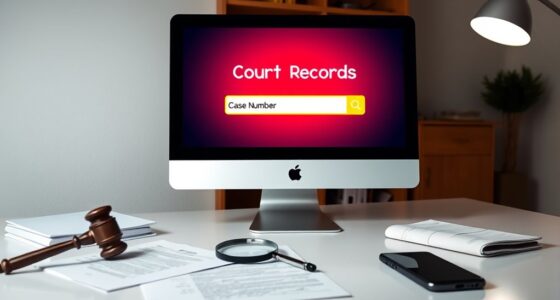

Remote court hearings have transformed how you access legal records by making them more available, secure, and easier to manage online. You can now access case files, transcripts, and evidence through digital platforms anytime and from anywhere, reducing delays and physical barriers. This shift promotes transparency and efficiency in justice. As a result, access to records is more inclusive and streamlined than ever before. Keep exploring to discover how this change impacts you and the justice system.
Key Takeaways
- Remote hearings enable instant online access to case records, increasing transparency and public availability.
- Digital records are easily searchable, organized, and preserved, enhancing record management efficiency.
- Virtual courtrooms allow parties to access evidence and documents in real-time, improving case transparency.
- Cloud-based repositories remove physical barriers, making records accessible regardless of location or mobility.
- Enhanced cybersecurity measures are essential to protect sensitive digital records from unauthorized access.
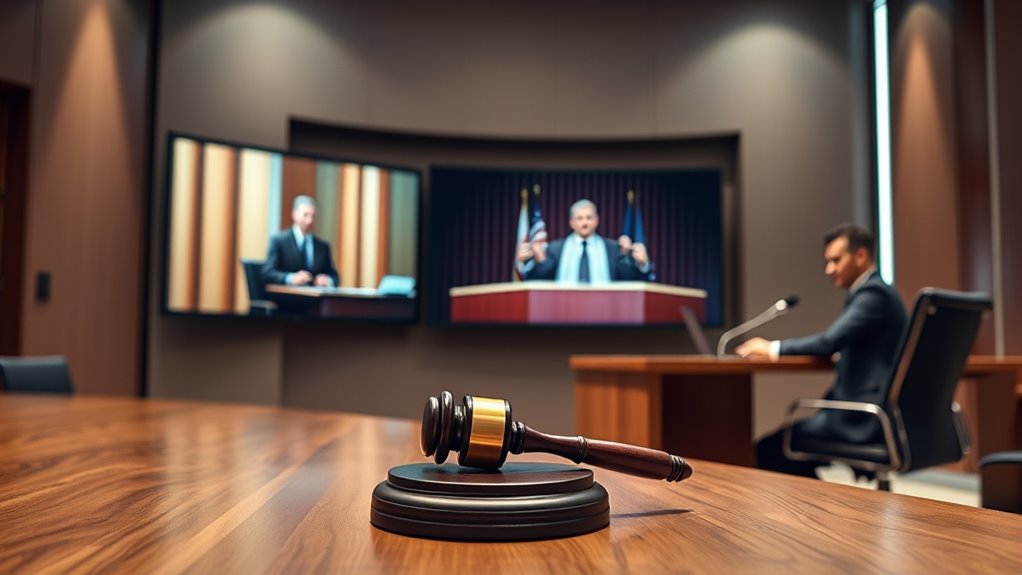
Have you ever wondered how court proceedings adapt to the digital age? The shift to remote court hearings has transformed how justice is served, making the process more accessible and efficient. Instead of gathering everyone in a physical courtroom, cases are now often handled through a virtual courtroom, where judges, attorneys, witnesses, and defendants connect via secure video platforms. This change isn’t just about convenience; it also impacts how records are accessed and managed. Digital evidence, for example, is now central to many cases, and the way it’s presented and stored has evolved dramatically.
Remote court hearings enhance accessibility and efficiency by enabling virtual access to digital evidence and records management.
In a virtual courtroom, digital evidence can be shared instantly, allowing all parties to review documents, videos, and other multimedia files in real-time. This immediacy streamlines proceedings, reduces delays, and minimizes the need for physical document exchanges. Instead of printing and distributing copies of records, parties upload evidence to a secure online portal. This method enhances transparency and guarantees everyone has access to the same information simultaneously, reducing misunderstandings or disputes over record versions. Plus, digital records are easier to organize, search, and preserve, contributing to a more efficient justice process.
Remote hearings also expand access to court records for the public and involved parties. Anyone with internet access can review case files, court transcripts, or evidence, often through online portals or repositories maintained by courts. This increased availability fosters transparency and allows journalists, legal professionals, or interested citizens to follow cases more closely. It also benefits litigants who may find it difficult to attend in-person hearings due to distance, health, or scheduling conflicts. By removing geographical barriers, remote court proceedings democratize access to justice and records.
However, the transition to digital records and virtual courtrooms introduces new challenges. Making certain that the security and privacy of sensitive information is maintained becomes paramount, especially with the increased reliance on online platforms. Courts must implement robust cybersecurity measures to prevent hacking or unauthorized access. Additionally, digital evidence must be carefully authenticated to maintain its integrity, as digital manipulation can pose risks. One key factor in this evolution is the mastering time zones, which ensures all participants can coordinate effectively across different locations and time zones. Despite these hurdles, the benefits of remote court hearings in making records more accessible and efficient are undeniable. They mark a significant step toward a more transparent, inclusive justice system where access to records is no longer confined by physical limitations. As technology continues to evolve, so will the ways courts handle evidence and records, shaping a future where justice is more accessible and records are easier to manage than ever before.
![WavePad Audio Editing Software - Professional Audio and Music Editor for Anyone [Download]](https://m.media-amazon.com/images/I/B1fcLEGCs6S._SL500_.png)
WavePad Audio Editing Software – Professional Audio and Music Editor for Anyone [Download]
Full-featured professional audio and music editor that lets you record and edit music, voice and other audio recordings
As an affiliate, we earn on qualifying purchases.
As an affiliate, we earn on qualifying purchases.
Frequently Asked Questions
How Secure Are Remote Court Hearing Platforms?
You’re wondering how secure remote court hearing platforms are. These platforms rely on strict cybersecurity protocols and user authentication measures to protect sensitive data. While they’re designed to prevent unauthorized access, no system is completely foolproof. You should stay vigilant, use strong passwords, and keep software updated. Overall, with proper security practices, remote hearing platforms provide a reasonably secure environment, but ongoing improvements are essential to stay ahead of potential threats.
Can Remote Hearings Be Recorded and Stored Permanently?
You can record remote hearings and store them permanently, thanks to digital documentation. Courts typically follow strict archival policies to guarantee these recordings are preserved securely and accessible when needed. By doing so, you gain a reliable record of proceedings that can be referenced long-term. This shift to digital storage makes it easier to maintain, retrieve, and manage court records, transforming how legal histories are preserved and accessed.
What Measures Protect Participant Privacy During Virtual Court Sessions?
Imagine a delicate web spun with care—that’s how courts protect privacy during virtual sessions. You’re shielded by privacy safeguards like encrypted video and secure login protocols, which act as walls to safeguard participant anonymity. These measures guarantee your voice remains confident and your identity protected, even as technology transforms courtroom access. By blending security with accessibility, courts aim to keep your participation safe from prying eyes while maintaining transparency.
Are Remote Court Records Accessible to the Public?
You can access remote court records online through case management systems, making it easier to find case details and digital evidence submissions. Public access varies by jurisdiction, but many courts provide online portals for viewing records, increasing transparency. However, some sensitive information remains protected. You should check specific court policies, as online case management platforms are designed to balance accessibility with privacy, ensuring important records are available while safeguarding confidential data.
How Do Remote Hearings Impact Court Transcript Accuracy?
You might think remote hearings compromise transcript accuracy, but with digital transcription and high audio fidelity, they often improve it. While some worry about background noise or tech issues, advances in audio quality and transcription software help capture every word clearly. You can trust that remote court transcripts are precise, especially when audio is recorded and reviewed thoroughly. So, remote hearings actually make court records more reliable, not less.

Sheffield 12629 Ammo Storage Box, Stackable .30 Cal Field Boxes, Water and Dust Resistant, Lockable Storage Box with Handle, Secures Hunting Gear, Supplies, and Bullets, Made in USA, Black, 1-Pack
Versatile Storage: Includes one standard-sized box. Perfect for .30 caliber, 9mm, 5.56 ammunition, and more. Great for storing…
As an affiliate, we earn on qualifying purchases.
As an affiliate, we earn on qualifying purchases.
Conclusion
So, congratulations! Thanks to remote court hearings, you now have the thrilling privilege of attending hearings from your pajamas, all while pretending to be fully attentive. Records are more accessible than ever—unless, of course, you enjoy deciphering audio glitches or missed details. Who knew that virtual justice would turn into a comedy of errors? But hey, at least now you can say you’ve experienced the courtroom revolution firsthand—without leaving your couch.
virtual courtroom video platform
As an affiliate, we earn on qualifying purchases.
As an affiliate, we earn on qualifying purchases.

ENGPOW Fireproof File Organizer Bag with 13 Colorful Pockets Accordion File Folder,5200℉ Document Organizer Box with Lock&Labels,Multi-Layer Portable Home Safe Storage for Important Documents,Files
Fireproof and Water-resistant: The multi-Layer file organizer is made of silicone coated material and aluminum foil which withstand…
As an affiliate, we earn on qualifying purchases.
As an affiliate, we earn on qualifying purchases.